What is lifetime employment?
One of the most famous stereotypes about Japan is that workers stay with the same company for their entire lives.
And for many decades, that stereotype was largely true.
For generations, millions of Japanese employees joined a company after graduating from school or university and remained there until retirement—sometimes for more than 40 years.
This system became known as lifetime employment, or shūshin koyō (終身雇用).
But does lifetime employment still exist in Japan today?
The answer is complicated.
While lifetime employment played a major role in building modern Japan, economic changes and shifting attitudes toward work have gradually transformed the country’s employment system.
In this article, we’ll explore what lifetime employment is, how it shaped Japanese society, and whether it still exists in modern Japan.
What Is Lifetime Employment?
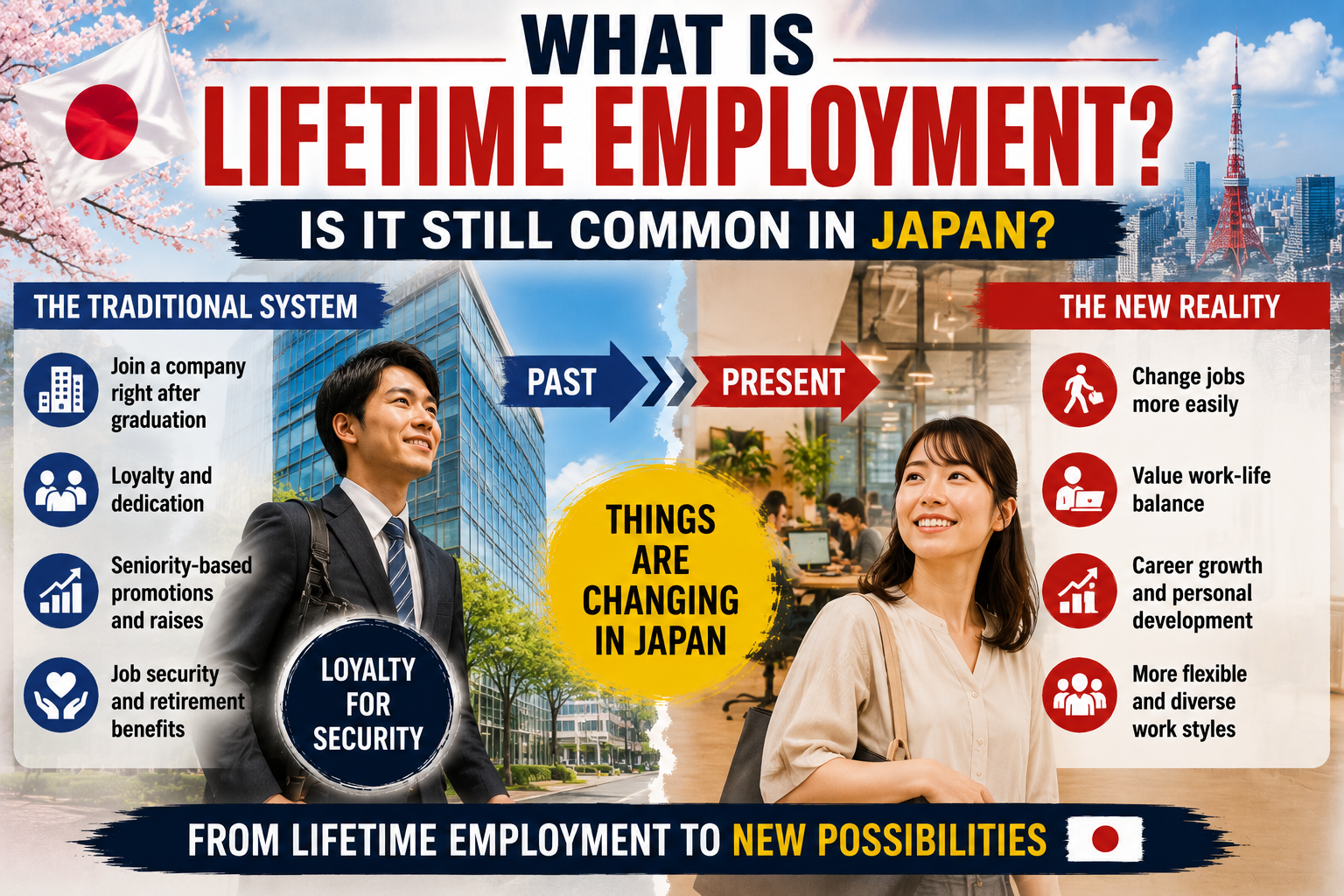
Lifetime employment, known as shūshin koyō, is an employment system in which workers remain with the same company for most or all of their careers.
Traditionally, employees would:
- Join a company immediately after graduation
- Work for the same employer for decades
- Receive regular promotions
- Earn salary increases based on seniority
- Retire from the same company
Changing jobs was often viewed as:
- Risky
- Unstable
- Unnecessary
- Sometimes even disloyal
For much of the postwar period, this system became one of the defining characteristics of Japanese society.
How Did Lifetime Employment Begin?
Lifetime employment became widespread after World War II.
At the time, Japan needed:
- Economic stability
- Social stability
- Reliable employment
- Long-term corporate growth
Large companies began offering workers:
- Job security
- Predictable salaries
- Promotions
- Retirement benefits
- Company welfare programs
In return, employees provided:
- Loyalty
- Hard work
- Long working hours
- Commitment to the company
This arrangement helped create the stable workforce that supported Japan’s rapid economic growth.
The Traditional Deal: Loyalty for Security
Lifetime employment was based on an unwritten agreement between companies and employees.
Employees provided:
- Loyalty
- Dedication
- Overtime work
- Long-term commitment
Companies provided:
- Job security
- Regular salary increases
- Promotions
- Benefits
- Retirement pensions
For many Japanese workers, their company became more than just an employer.
It became:
- A community
- A social network
- A source of identity
- A source of financial security
This system shaped Japanese workplace culture for generations.
Why Did Lifetime Employment Work So Well?
Several factors allowed the system to succeed.
Rapid Economic Growth
Japan’s postwar economy expanded rapidly for decades.
Growing companies could afford to guarantee long-term employment.
Seniority-Based Pay
Employees accepted lower salaries when they were young because they expected higher salaries later in their careers.
Strong Company Loyalty
Workers often identified strongly with their employer and valued stability over personal advancement.
Limited Job Mobility
Changing jobs was relatively uncommon, which reinforced the entire system.
For many decades, the arrangement benefited both employers and employees.
Is Lifetime Employment Still Common in Japan?
Not really.
Although some large companies still maintain elements of lifetime employment, the traditional system has weakened significantly.
Several factors contributed to its decline:
- Economic stagnation
- Global competition
- Aging demographics
- Rising labor costs
- Technological change
- Changing worker expectations
Today, many Japanese companies can no longer guarantee employment for an entire lifetime.
Younger Workers Think Differently
Perhaps the biggest change has been generational.
Many younger Japanese workers now prioritize:
- Work-life balance
- Mental health
- Career growth
- Personal happiness
- Flexibility
- Higher salaries
Unlike previous generations, many younger workers no longer expect to stay with one company forever.
In fact, changing jobs has become increasingly common.
What was once considered risky or disloyal is now often viewed as a normal career strategy.
The Rise of Mid-Career Hiring
Traditionally, Japanese companies hired employees almost exclusively when they graduated from school.
Mid-career hiring, known as chūto saiyō (中途採用), was relatively rare.
Today, however, mid-career recruitment has become much more common.
Many workers now change jobs to:
- Increase their salary
- Improve work-life balance
- Escape toxic workplaces
- Find better career opportunities
- Pursue more meaningful work
As a result, Japan’s labor market has become much more flexible than it was in the past.
Non-Regular Employment Is Also Increasing
Another major change is the growth of non-regular employment.
Today, many workers are employed as:
- Part-time workers
- Contract employees
- Temporary workers
- Freelancers
- Independent contractors
While this creates greater flexibility, it also means that many workers have less job security than previous generations.
This shift has fundamentally changed Japan’s employment landscape.
Why Are Foreigners Fascinated by Lifetime Employment?
For many foreigners, lifetime employment seems almost impossible to imagine.
In many Western countries:
- Changing jobs is common
- Career mobility is encouraged
- Salary increases often require switching employers
- Loyalty to a company is less important
Japan’s traditional employment system therefore appears unique and even surprising.
However, understanding lifetime employment helps explain many aspects of Japanese society, including:
- Long working hours
- Company loyalty
- Seniority systems
- Workplace hierarchy
- Resistance to change
Will Lifetime Employment Disappear Completely?
Probably not.
Some large traditional companies still value long-term employment relationships.
However, most experts believe that Japan will continue moving toward:
- Greater job mobility
- Flexible employment
- Performance-based evaluation
- Mid-career hiring
- Diverse career paths
The era when most Japanese workers spent their entire careers at one company is gradually coming to an end.
FAQ
What is lifetime employment in Japan?
Lifetime employment, or shūshin koyō, is a system in which employees work for the same company throughout most of their careers.
Is lifetime employment still common in Japan?
Not really. While some traditional companies still practice it, the system has declined significantly.
Why did Japan adopt lifetime employment?
The system developed after World War II to promote economic growth, social stability, and corporate loyalty.
Do young Japanese workers want lifetime employment?
Many younger workers now prefer flexibility, career mobility, and better work-life balance.
Why is understanding lifetime employment important?
It helps explain many aspects of Japanese workplace culture, including loyalty, hierarchy, overtime, and attitudes toward work.