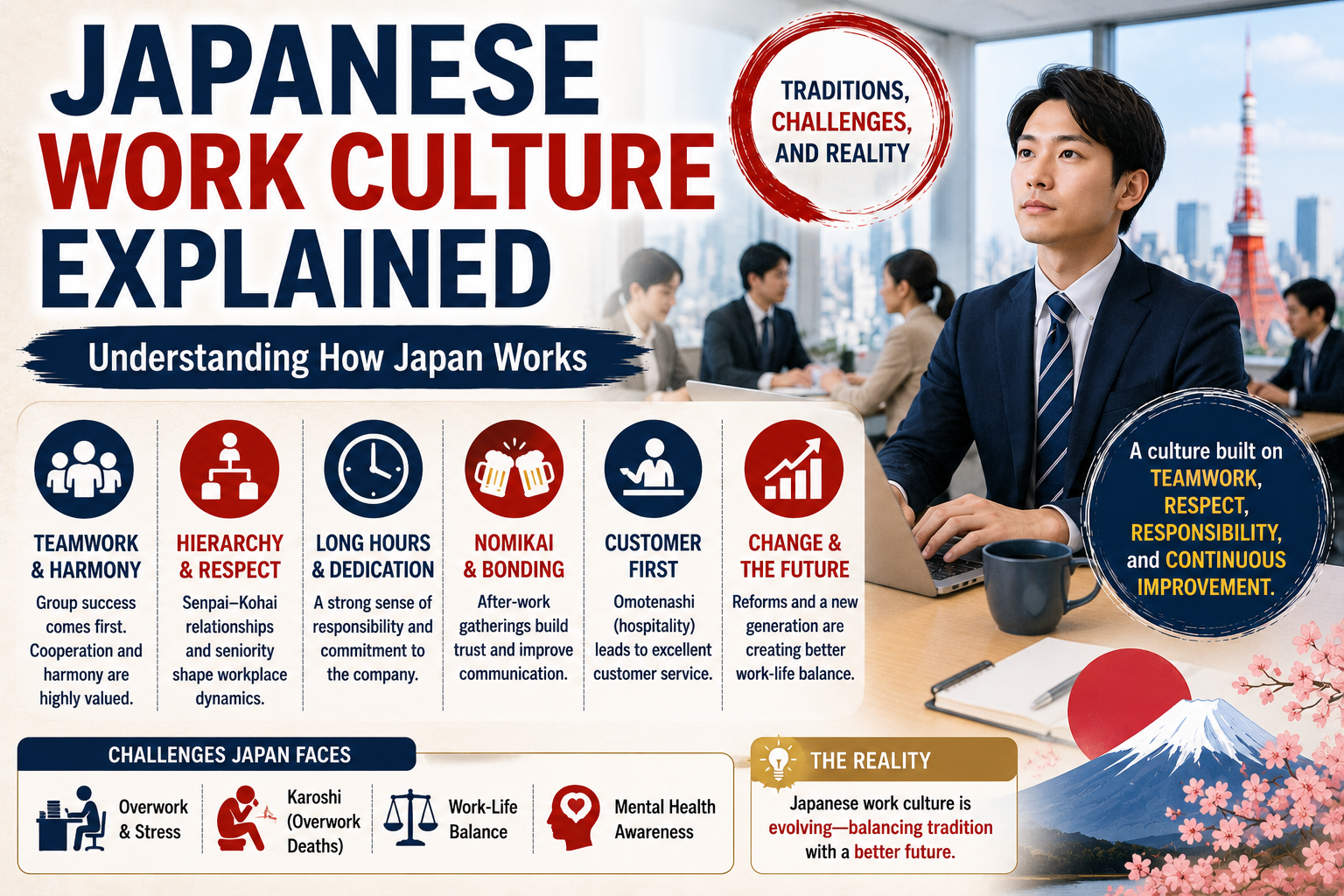
Japanese work culture has fascinated people around the world for decades.
Many foreigners imagine Japanese offices as places where employees:
- Work extremely long hours.
- Never leave before their boss.
- Attend endless drinking parties.
- Sacrifice their personal lives for their companies.
But how much of this is true?
The reality of Japanese work culture is far more complex.
While Japan is famous for its strong work ethic, loyalty, and professionalism, modern Japanese workplaces are also undergoing major changes.
In this article, we’ll explore the traditions, values, challenges, and realities of Japanese work culture.
Why Is Japanese Work Culture So Famous?
Japan’s work culture gained international attention because of its reputation for:
- Long working hours
- Strong company loyalty
- Discipline
- Group cooperation
- Exceptional customer service
During Japan’s economic boom of the 1960s through the 1980s, employees often dedicated much of their lives to their companies.
This period helped create the global image of the hardworking Japanese “salaryman.”
Although some aspects of this image remain true, many parts of Japanese work culture have evolved significantly.
The Importance of Group Harmony (Wa)
One of the most important concepts in Japanese workplaces is:
Wa (和) — harmony.
Japanese companies often prioritize:
- Teamwork
- Cooperation
- Consensus
- Respectful communication
- Group success
Unlike some cultures that emphasize individual achievement, Japanese workplaces traditionally value collective performance.
Employees often ask:
“What’s best for the team?”
rather than:
“What’s best for me?”
Hierarchy Is Important
Japanese workplaces tend to have clear hierarchical structures.
Respect is often shown based on:
- Age
- Experience
- Position
- Seniority
This system is known as:
Senpai-Kohai (先輩・後輩)
where:
- Senpai = senior employee
- Kohai = junior employee
Senior employees often provide guidance and mentorship, while junior employees show respect and support.
Although modern companies are becoming less formal, hierarchy remains an important part of Japanese business culture.
Why Do Japanese People Work Such Long Hours?
Japan has long been associated with long working hours.
Several factors contribute:
Strong Sense of Responsibility
Many employees feel responsible for supporting their colleagues and company.
Group Pressure
Leaving before coworkers or supervisors can sometimes create social pressure.
Company Loyalty
Traditionally, employees often viewed the company almost as an extended family.
Workplace Expectations
In some workplaces, dedication has historically been measured by visible effort rather than productivity alone.
However, this culture has gradually been changing.
What Is Karoshi?
One of the darker aspects of Japanese work culture is:
Karoshi (過労死)
which literally means:
“Death from overwork.”
Karoshi refers to deaths associated with:
- Excessive overtime
- Stress
- Exhaustion
- Work-related health problems
The international attention given to karoshi has contributed to major workplace reforms in Japan.
Today, both companies and the government are actively attempting to reduce excessive working hours.
Why Don’t Employees Leave Before Their Boss?
One of the most famous stereotypes about Japan is:
“Nobody leaves until the boss leaves.”
While this practice still exists in some workplaces, especially traditional companies, it has become less common than many foreigners imagine.
Historically, staying late demonstrated:
- Loyalty
- Commitment
- Team spirit
- Respect
Today, younger workers increasingly prioritize:
- Productivity
- Efficiency
- Work-life balance
rather than simply remaining at the office.
What Are Nomikai?
Another famous aspect of Japanese work culture is:
Nomikai (飲み会)
or after-work drinking parties.
These gatherings traditionally serve several purposes:
- Building trust
- Improving communication
- Strengthening team relationships
- Expressing personal opinions more openly
During nomikai, employees often feel more comfortable expressing their:
- Honne (true feelings)
- Concerns
- Personal experiences
However, participation in nomikai has declined among younger generations.
Why Is Customer Service So Good in Japan?
Japanese workplaces place enormous importance on:
- Professionalism
- Courtesy
- Attention to detail
- Responsibility
This is closely connected to the concept of:
Omotenashi (おもてなし)
or wholehearted hospitality.
Employees often strive to provide exceptional service because doing so reflects positively on:
- The company
- Their colleagues
- Themselves
This helps explain why customer service in Japan is often considered among the best in the world.
Is Japanese Work Culture Stressful?
It can be.
Common challenges include:
- Long working hours
- Social pressure
- Workplace hierarchy
- Indirect communication
- Expectations of conformity
These factors have contributed to concerns about:
- Mental health
- Burnout
- Work-life balance
As a result, improving workplace conditions has become a major social issue in Japan.
Is Japanese Work Culture Changing?
Yes—significantly.
Several factors are driving change:
Younger Generations
Many younger workers prioritize:
- Personal time
- Flexibility
- Work-life balance
- Career mobility
Government Reforms
Japan has introduced policies aimed at:
- Reducing overtime
- Encouraging vacations
- Improving productivity
Globalization
International business practices have influenced many Japanese companies.
Remote Work
The COVID-19 pandemic accelerated the adoption of:
- Telework
- Flexible schedules
- Digital communication
As a result, modern Japanese workplaces vary widely.
What Foreigners Often Misunderstand About Japanese Work Culture
Many foreigners assume that Japanese workers are simply “workaholics.”
However, Japanese work culture is often motivated by values such as:
- Responsibility
- Loyalty
- Respect
- Group harmony
- Professionalism
While some aspects can appear excessive from an outside perspective, many employees genuinely value the sense of belonging and purpose that work provides.
What Japanese Work Culture Reveals About Japanese Society
Japanese work culture reflects many of the country’s core values:
- Cooperation
- Responsibility
- Respect
- Discipline
- Harmony
- Commitment
At the same time, modern Japan continues to balance these traditional values with growing demands for flexibility and individual well-being.
Understanding Japanese work culture provides important insight into how Japanese society itself functions.
FAQ
Do Japanese people really work long hours?
Some do, although average working hours have decreased significantly in recent decades.
What is a salaryman?
A salaryman is a white-collar employee who traditionally works for a Japanese company full-time.
What is karoshi?
Karoshi refers to death associated with excessive work-related stress or overwork.
Are nomikai mandatory?
Usually not officially, but social pressure may encourage participation.
Is Japanese work culture changing?
Yes. Younger generations and workplace reforms are changing traditional practices.