If you’ve spent time in Japan or interacted closely with Japanese people, you may have heard the terms Tatemae and Honne.
Many foreigners describe these concepts as confusing or even frustrating. Why do Japanese people sometimes say one thing but mean another? Why do they avoid direct confrontation? And how can you tell what someone is really thinking?
The concepts of tatemae and honne are among the most important keys to understanding Japanese society, relationships, and communication.
In this article, we’ll explain what tatemae and honne really mean, why they exist, and how they influence everyday life in Japan.
What Do Tatemae and Honne Mean?
Simply put:
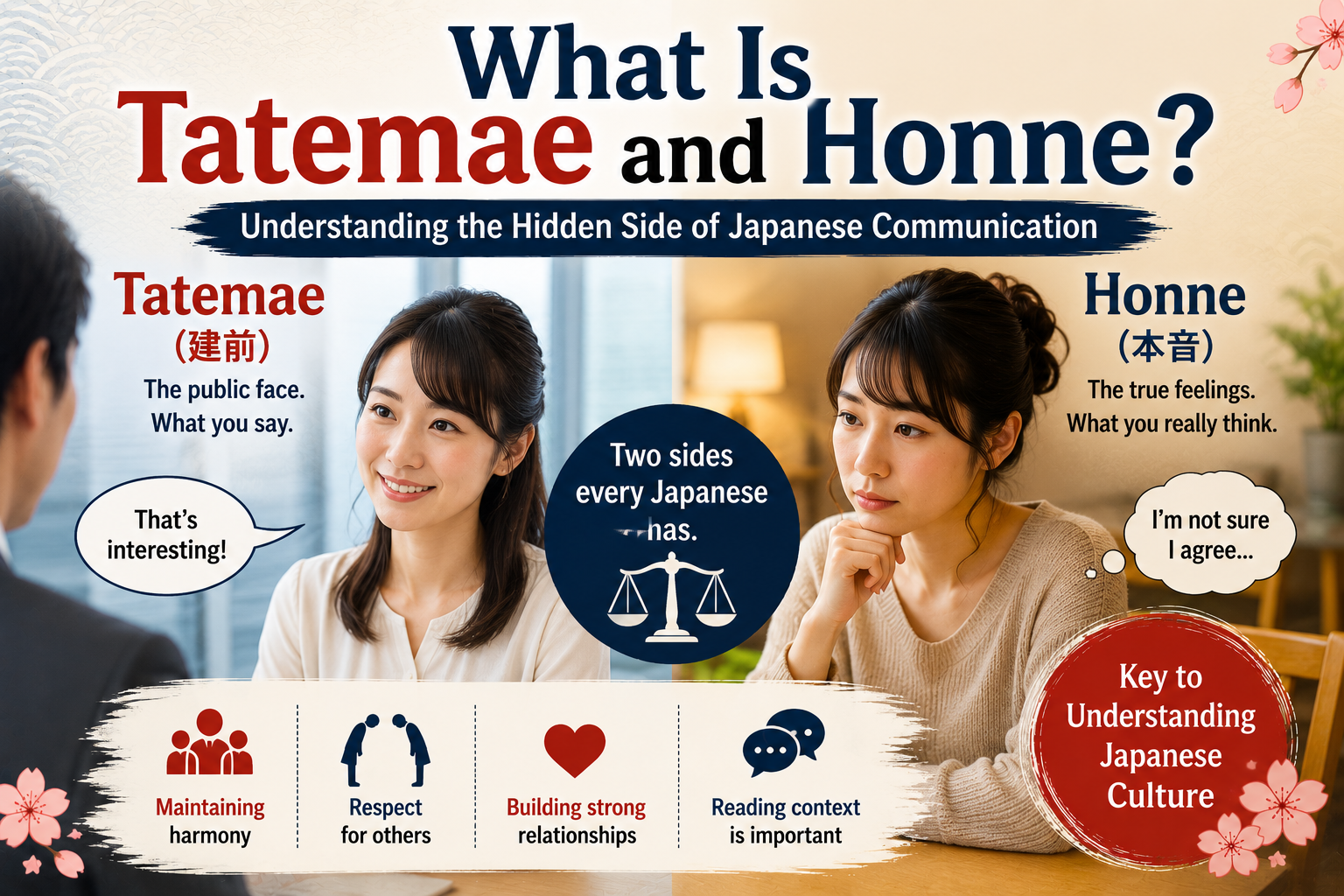
- Honne (本音) = a person’s true feelings, opinions, and desires.
- Tatemae (建前) = the public face or socially acceptable response presented to others.
This doesn’t necessarily mean that Japanese people are dishonest.
Rather, these concepts help people balance:
- Personal feelings
- Social harmony
- Relationships
- Group expectations
Understanding this distinction is essential for understanding Japanese culture.
What Is Honne?
Honne literally means “true sound” or “real feelings.”
It refers to:
- What a person genuinely thinks
- Their private opinions
- Their personal preferences
- Their authentic emotions
Examples of honne include:
- Disliking a social event
- Disagreeing with a coworker
- Feeling tired of work
- Being unhappy in a relationship
However, people may not always express these feelings openly.
What Is Tatemae?
Tatemae literally means “facade” or “public stance.”
It refers to the behavior and statements people use to maintain:
- Social harmony
- Politeness
- Professional relationships
- Group cohesion
Examples of tatemae include:
- Saying “Maybe next time” instead of directly saying “No.”
- Agreeing politely during a meeting despite personal disagreement.
- Accepting an invitation out of courtesy.
- Avoiding criticism in public.
Tatemae helps prevent conflict and preserve relationships.
Why Do Tatemae and Honne Exist?
The answer lies in one of Japan’s most important cultural values:
Wa (和) — social harmony.
Japanese society has historically placed great importance on:
- Cooperation
- Group harmony
- Mutual respect
- Avoiding conflict
- Maintaining relationships
Expressing every personal opinion openly could disrupt harmony and create unnecessary tension.
Tatemae developed as a social tool that allows people to coexist peacefully.
Does Tatemae Mean Japanese People Are Fake?
No.
This is one of the biggest misunderstandings foreigners have about Japanese culture.
Many Western cultures value:
- Directness
- Individual expression
- Personal authenticity
Japanese culture often prioritizes:
- Consideration for others
- Maintaining harmony
- Preserving relationships
Using tatemae isn’t usually considered dishonest.
Instead, it’s often viewed as:
- Being polite
- Being considerate
- Being socially responsible
From a Japanese perspective, blunt honesty can sometimes be seen as rude or selfish.
Examples of Tatemae in Everyday Life
Foreigners living in Japan often encounter tatemae without realizing it.
Example 1: Invitations
A Japanese friend says:
“Let’s have dinner sometime.”
This may mean:
- They genuinely want to meet.
- They are simply being polite.
Without further planning, it’s often difficult to know which.
Example 2: Business Meetings
A coworker says:
“We’ll consider your proposal.”
This could mean:
- They are interested.
- They are politely rejecting the idea.
Example 3: Compliments
Someone says:
“Your Japanese is very good!”
Sometimes this is sincere praise.
Sometimes it’s simply a polite way of encouraging conversation.
When Do Japanese People Show Their Honne?
Honne is usually expressed only in situations involving trust and intimacy.
Examples include:
- Close friends
- Romantic partners
- Family members
- Trusted coworkers
- Private social gatherings
After drinking alcohol, Japanese people may also express their honne more openly.
This is one reason why after-work drinking parties (nomikai) have traditionally played an important role in Japanese business culture.
Tatemae and Japanese Dating
Understanding tatemae and honne is especially important when dating Japanese people.
For example:
A Japanese person might say:
“I’m busy these days.”
This could mean:
- They are genuinely busy.
- They are politely declining further dates.
Similarly, expressions of affection may be more subtle than what many foreigners expect.
Reading context and actions often matters more than interpreting words literally.
Tatemae and Japanese Work Culture
Tatemae also strongly influences Japanese workplaces.
Employees may:
- Avoid openly criticizing management.
- Hide personal dissatisfaction.
- Prioritize group consensus.
- Express disagreement indirectly.
This approach helps maintain workplace harmony but can sometimes confuse foreign employees who expect direct communication.
Can Foreigners Understand Tatemae?
Yes—but it takes time.
Many foreigners initially find Japanese indirect communication frustrating.
However, understanding tatemae becomes easier when you focus on:
- Context
- Body language
- Tone of voice
- Relationship dynamics
- Actions rather than words
Eventually, many foreigners living in Japan begin to recognize subtle patterns of communication.
Is Tatemae Changing in Modern Japan?
To some extent, yes.
Younger generations often value:
- Greater honesty
- Individual expression
- Open communication
Social media and globalization have also influenced communication styles.
However, tatemae and honne remain deeply embedded in Japanese culture and continue to shape everyday interactions.
What Tatemae and Honne Reveal About Japanese Society
Tatemae and honne reflect several important Japanese values:
- Social harmony
- Respect
- Group cooperation
- Consideration for others
- Emotional self-control
Rather than seeing tatemae as “fake” and honne as “real,” it’s more helpful to understand both as tools for maintaining human relationships.
For many foreigners, learning about tatemae and honne becomes one of the most fascinating ways to understand how Japanese society functions.
FAQ
What is the difference between tatemae and honne?
Honne refers to a person’s true feelings, while tatemae refers to the socially acceptable behavior or opinion they present publicly.
Are Japanese people dishonest because of tatemae?
No. Tatemae is generally viewed as a way to maintain social harmony and show consideration for others.
Why do Japanese people avoid saying “no” directly?
Direct refusal can create conflict or embarrassment, so indirect communication is often preferred.
Is tatemae common in Japanese business?
Yes. Indirect communication and maintaining harmony play important roles in many workplaces.
Can foreigners learn to recognize tatemae?
Absolutely. With experience and cultural understanding, recognizing tatemae becomes easier.