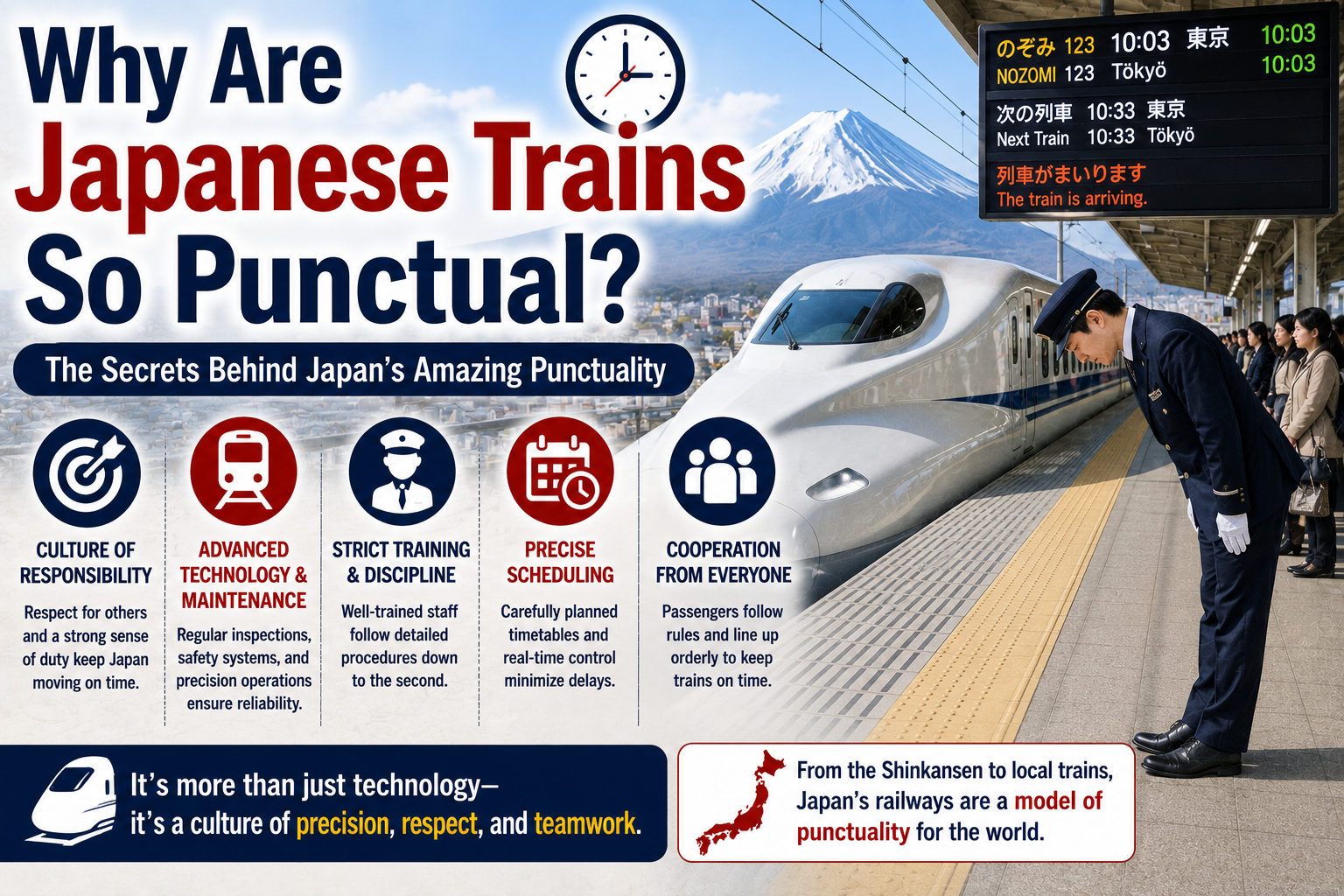
One of the first things many visitors notice in Japan is that the trains seem to run with incredible precision.
A train scheduled to depart at:
10:03
often leaves at:
Exactly 10:03.
In some cases, train companies have even apologized publicly for departures that were only seconds early or late.
This leads many foreigners to ask:
Why are Japanese trains so punctual?
The answer involves much more than technology. Japan’s railway punctuality reflects cultural values, operational efficiency, infrastructure investment, and a strong sense of responsibility.
In this article, we’ll explore the real reasons why Japan has some of the most punctual trains in the world.
Are Japanese Trains Really That Punctual?
Yes.
Japan’s railways are internationally famous for their reliability.
Many trains operate with average delays measured in:
- Seconds
- Not minutes
This is particularly true for:
- Urban commuter railways
- Subway systems
- The Shinkansen (bullet train)
For many Japanese people, arriving even a few minutes late can be considered unusual.
Why Is Punctuality So Important in Japan?
One of the biggest reasons is cultural.
Japanese society places a high value on:
- Responsibility
- Reliability
- Respect for others
- Professionalism
- Social harmony
Being late is often viewed as causing inconvenience to other people.
This concept is closely related to:
Meiwaku wo kakenai (迷惑をかけない)
which means:
“Do not cause trouble or inconvenience to others.”
Because trains transport millions of passengers every day, punctuality becomes a social responsibility.
Railway Companies Invest Heavily in Precision
Japanese railway operators spend enormous amounts of money on:
- Infrastructure maintenance
- Safety systems
- Staff training
- Scheduling technology
- Operational management
Regular inspections and maintenance help reduce:
- Equipment failures
- Mechanical problems
- Unexpected delays
This continuous investment plays a major role in maintaining reliability.
Train Schedules Are Carefully Designed
Japanese train schedules are famous for their precision.
Railway companies carefully calculate:
- Departure times
- Arrival times
- Passenger flow
- Transfer connections
- Platform usage
Even a delay of one or two minutes can affect thousands of passengers and multiple train lines.
As a result, train operations are managed with extraordinary attention to detail.
Staff Training Is Extremely Strict
Japanese railway employees undergo extensive training.
Train staff are expected to demonstrate:
- Accuracy
- Discipline
- Safety awareness
- Professionalism
- Responsibility
One famous example is a safety procedure called:
Shisa Kanko (指差確認)
or:
“Pointing and calling.”
Workers physically point at signals, clocks, and indicators while verbally confirming them.
This technique helps reduce human error and improve concentration.
The Shinkansen Is a Global Symbol of Punctuality
Perhaps the most famous example of Japanese punctuality is the:
Shinkansen (bullet train).
The Shinkansen network is known for:
- Exceptional safety
- High speeds
- Reliability
- Precision
Despite carrying millions of passengers annually, average delays on many Shinkansen lines are often measured in seconds.
This level of reliability has made Japan’s bullet trains famous worldwide.
Japanese Passengers Also Help Keep Trains On Time
Train punctuality is not only the responsibility of railway companies.
Passengers also contribute by:
- Forming orderly queues
- Boarding efficiently
- Following station rules
- Avoiding disruptive behavior
- Respecting schedules
This cooperation helps maintain smooth operations, especially during rush hour.
Why Do Train Companies Apologize for Small Delays?
Foreign visitors are often surprised to hear public apologies for delays of only a few minutes.
In Japan, railway companies often apologize because:
- Customers expect reliability.
- Delays inconvenience passengers.
- Professional responsibility is taken seriously.
In some cases, train companies even issue:
Delay certificates (chien shoumeisho)
that commuters can show to employers or schools.
What Causes Delays in Japan?
Despite their reputation, Japanese trains are not perfect.
Common causes of delays include:
- Typhoons
- Earthquakes
- Heavy snow
- Equipment failures
- Accidents
- Passenger emergencies
However, railway companies usually work quickly to restore normal operations.
Why Are Japanese Trains Cleaner and Quieter?
The same cultural values that promote punctuality also influence:
- Cleanliness
- Orderliness
- Passenger behavior
Passengers generally:
- Avoid loud conversations
- Respect personal space
- Follow rules
- Dispose of trash properly
This helps create the calm, efficient atmosphere that many visitors associate with Japanese trains.
Is Japanese Train Punctuality Changing?
As passenger numbers increase and weather patterns become more unpredictable, maintaining perfect punctuality has become more challenging.
However, Japan’s railway industry continues investing in:
- Automation
- AI technology
- Safety systems
- Operational efficiency
As a result, Japanese trains remain among the most reliable transportation systems in the world.
What Japanese Train Punctuality Reveals About Japanese Culture
The punctuality of Japanese trains reflects several core values of Japanese society:
- Responsibility
- Respect
- Discipline
- Professionalism
- Cooperation
- Consideration for others
Japanese trains are not punctual simply because of technology.
They are punctual because millions of people—from railway employees to passengers—cooperate to ensure the system functions smoothly.
Understanding why Japanese trains run on time provides a deeper understanding of how Japanese society itself operates.
FAQ
Are Japanese trains really the most punctual in the world?
Japan is widely considered to have one of the world’s most punctual railway systems.
What happens if Japanese trains are delayed?
Railway companies often issue delay certificates and work quickly to restore service.
What is “pointing and calling”?
It is a Japanese safety method where workers physically point and verbally confirm tasks to reduce mistakes.
Why do Japanese people line up for trains?
Orderly boarding helps improve efficiency and maintain punctuality.
Does the Shinkansen ever run late?
Yes, but average delays are often measured in seconds rather than minutes.