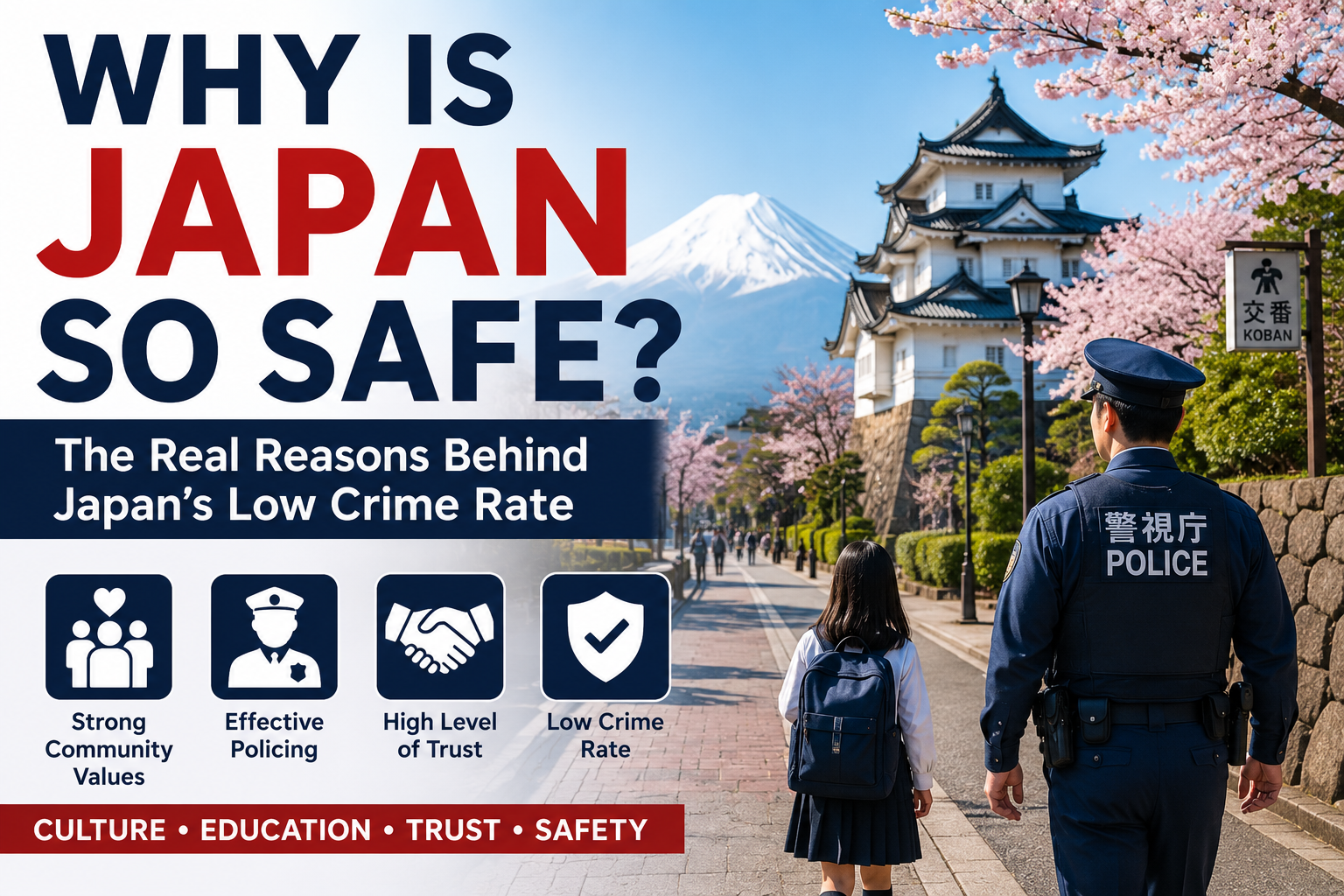
Japan is really safe, consistently ranks as one of the safest countries in the world.
For many foreign visitors, some experiences in Japan can feel almost unbelievable:
- People leave laptops unattended in cafés.
- Children ride trains alone.
- Lost wallets are often returned with the cash still inside.
- Women can walk alone late at night in many areas without feeling unsafe.
This often leads foreigners to ask:
“Why is Japan so safe?”
The answer is complex. Japan’s safety isn’t due to a single factor but rather a combination of cultural values, social systems, education, policing, and economic stability that have developed over centuries.
In this article, we’ll explore the real reasons behind Japan’s remarkably low crime rate and why the country feels so safe compared to many other developed nations.
Japan Has One of the Lowest Crime Rates in the World
Japan consistently records lower rates of violent crime than many Western countries.
Crimes such as:
- Homicide
- Armed robbery
- Street violence
- Gun-related crime
occur relatively infrequently compared to countries like the United States, the United Kingdom, or many parts of Europe.
This doesn’t mean crime doesn’t exist in Japan. Crimes such as fraud, cybercrime, stalking, and organized crime still occur. However, everyday violent crime remains relatively rare.
As a result, ordinary people often feel comfortable going about their daily lives with less concern about personal safety.
Japanese Culture Strongly Emphasizes Social Harmony
One of the most important reasons for Japan’s safety is its cultural emphasis on social harmony.
In Japanese society, maintaining harmony within the community is highly valued.
Many Japanese people grow up learning concepts such as:
- Avoid causing trouble for others
- Respect public spaces
- Follow social rules
- Consider how your actions affect the group
This social pressure discourages behaviors that could disrupt society.
While every country has laws, Japan’s cultural expectations often encourage people to regulate their own behavior before legal consequences become necessary.
Japan Has High Levels of Social Trust
Japan has historically maintained relatively high levels of trust among its citizens.
Examples include:
- Leaving personal belongings unattended
- Returning lost property
- Following rules without strict enforcement
- Respecting shared spaces
Many foreigners are surprised to discover that lost items are frequently turned in to police stations or lost-and-found offices.
This culture of trust creates a positive cycle: when people expect others to behave honestly, they are more likely to behave honestly themselves.
Strict Gun Laws Reduce Violent Crime
Japan has some of the strictest gun control laws in the world.
Private ownership of firearms is heavily restricted and requires:
- Extensive background checks
- Mental health evaluations
- Written examinations
- Practical training
- Police inspections
As a result, gun-related deaths in Japan are extremely rare compared to countries with widespread firearm ownership.
Of course, gun laws alone do not explain Japan’s safety, but they significantly reduce the likelihood of violent crime involving firearms.
Japan’s Police System Is Highly Visible
Japan’s police force operates a unique neighborhood policing system called the koban system.
A koban is a small local police station found throughout cities and neighborhoods.
Police officers working in koban stations often:
- Patrol neighborhoods on foot or by bicycle
- Provide directions to tourists
- Handle lost property
- Build relationships with local residents
- Respond quickly to minor incidents
This visible police presence helps discourage crime and increases public confidence.
Children Learn Social Responsibility From an Early Age
Japanese children are often taught independence and responsibility from a young age.
For example, children commonly:
- Walk to school by themselves
- Clean their classrooms
- Serve lunch to classmates
- Participate in community activities
Schools also place strong emphasis on:
- Respect
- Cooperation
- Discipline
- Personal responsibility
These values can contribute to stronger social norms and lower levels of antisocial behavior later in life.
Economic Stability Plays an Important Role
Although Japan faces economic challenges, it remains a relatively wealthy and stable society.
Factors that contribute to social stability include:
- Low levels of extreme poverty
- Universal healthcare
- High literacy rates
- Strong public infrastructure
- Relatively low income inequality compared to some countries
Economic stability does not eliminate crime, but it can reduce some of the conditions that contribute to higher crime rates.
Japanese Cities Are Designed to Be Safe
Urban design also contributes to Japan’s safety.
Many Japanese cities feature:
- Excellent public transportation
- Brightly lit streets
- Active neighborhoods
- Convenience stores open 24 hours
- Extensive surveillance systems
- High population density
Unlike isolated suburban areas, Japanese urban neighborhoods often remain active late into the evening, which can discourage criminal activity.
Is Japan Really Completely Safe?
Despite its reputation, Japan is not a crime-free country.
Problems that still exist include:
- Scams and fraud
- Cybercrime
- Stalking
- Domestic violence
- Sexual harassment
- Organized crime activities
Tourists should still take normal precautions, especially in nightlife districts and crowded tourist areas.
No country is perfectly safe, and Japan is no exception.
Why Foreigners Often Feel Shocked by Japan’s Safety
Many visitors experience “culture shock” because Japan’s level of everyday safety differs significantly from what they are used to.
Common surprises include:
- Seeing children travel alone
- Finding lost property returned
- Walking safely at night
- Seeing bicycles left unlocked
- Experiencing very little street harassment
For many travelers, Japan becomes the benchmark by which they judge safety in other countries.
Final Thoughts
Japan’s reputation as one of the safest countries in the world is the result of many interconnected factors:
- Strong social norms
- Cultural emphasis on harmony
- High levels of social trust
- Strict gun laws
- Effective community policing
- Early education in responsibility
- Economic stability
- Safe urban design
While Japan is not a perfect society, its approach to social order and community responsibility has created an environment where many people feel unusually safe in their everyday lives.
Understanding why Japan is so safe offers valuable insight into the values and systems that shape Japanese society.
FAQ
Is Japan the safest country in the world?
Japan is consistently ranked among the safest countries in the world, although rankings vary depending on the criteria used.
Why can Japanese children travel alone?
Japanese society places a strong emphasis on community responsibility, public safety, and teaching independence from a young age.
Why are lost items often returned in Japan?
High levels of social trust and cultural expectations about honesty encourage many people to return lost property.
Does Japan have violent crime?
Yes, but violent crime rates are relatively low compared to many other developed countries.
Is Japan completely safe for tourists?
Japan is generally very safe for tourists, but visitors should still take normal precautions against scams, theft, and other crimes.