When many people think of Japan, they imagine crowded cities, packed trains, and one of the world’s highest population densities.That’s why many foreigners are shocked to learn that Japan has millions of empty houses.
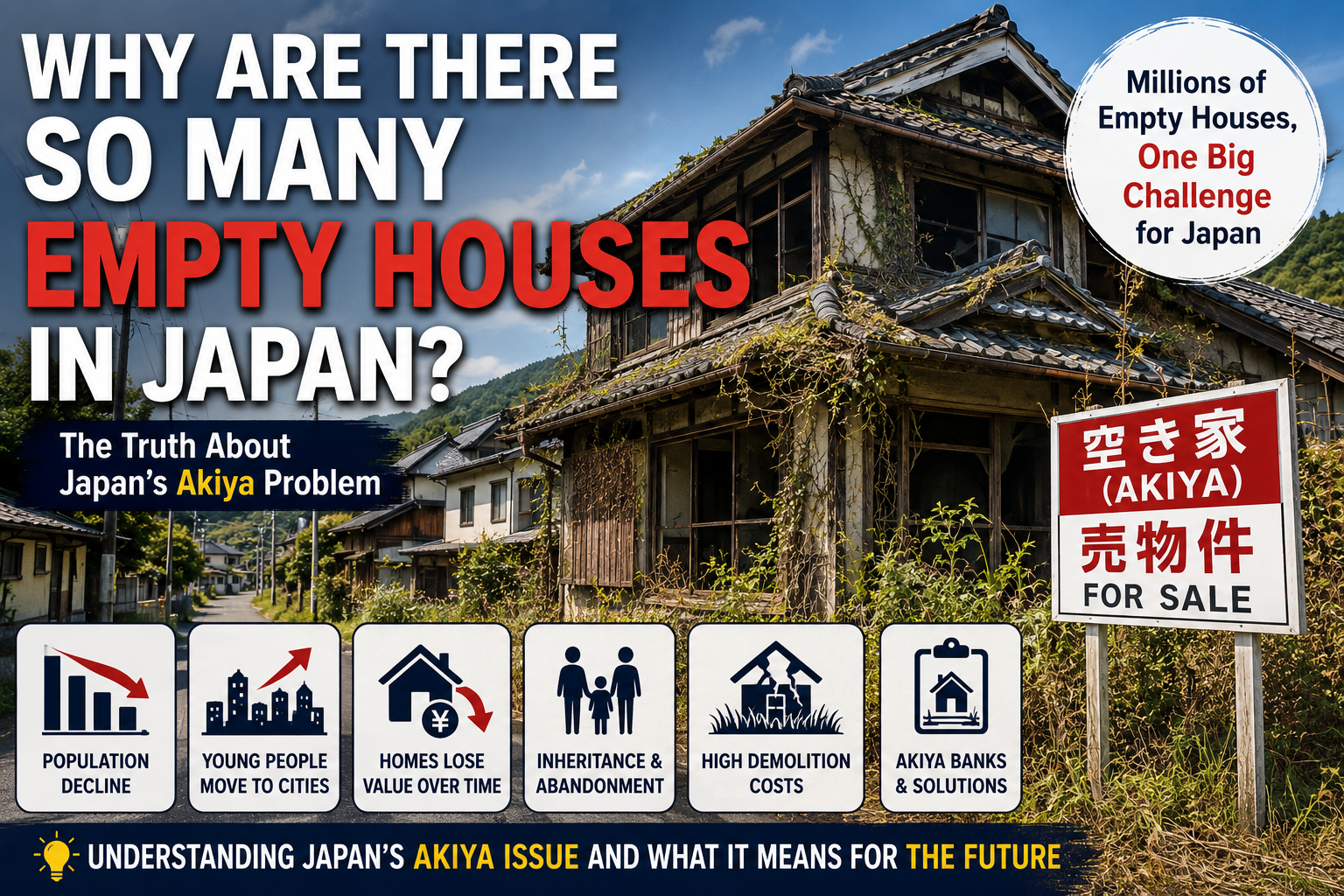
In fact, abandoned and vacant homes—known in Japan as “akiya” (空き家)—have become one of the country’s biggest social and economic challenges.
Some of these homes are so unwanted that local governments have offered them for extremely low prices—or even for free.
This naturally raises an important question:
“Why are there so many empty houses in Japan?”
The answer involves population decline, aging communities, cultural attitudes toward housing, and major demographic changes that are reshaping Japanese society.
In this article, we’ll explore the real reasons behind Japan’s growing akiya problem and what it means for the country’s future.
Japan’s Population Is Shrinking
The biggest reason for Japan’s empty house problem is simple:
Japan’s population is declining.
Japan’s population peaked around 2008 and has been decreasing ever since due to:
- Low birth rates
- An aging population
- Fewer marriages
- Fewer children being born
As the population shrinks, fewer people are available to occupy existing homes.
This problem is especially severe in rural areas, where young people often move to major cities for education and employment.
As a result, entire neighborhoods can gradually become abandoned.
Young People Are Moving to Big Cities
Japan remains highly concentrated around major urban areas such as:
- Tokyo
- Osaka
- Nagoya
- Fukuoka
Many young Japanese leave rural hometowns because cities offer:
- Better job opportunities
- Higher salaries
- Universities
- Greater convenience
- More entertainment options
When elderly residents pass away, their family homes often remain empty because younger generations have no intention of moving back.
This phenomenon has created thousands of “ghost villages” and communities with rapidly declining populations.
Japanese Homes Lose Value Over Time
One surprising aspect of Japan’s housing market is that homes are often treated differently than in many Western countries.
In countries such as the United States or Canada, houses frequently appreciate in value.
In Japan, however:
- The land typically retains value.
- The building itself often depreciates.
Many Japanese homes are considered to have a useful lifespan of around 30 to 40 years.
As a result, buyers often prefer purchasing newly built homes rather than older properties.
This creates a situation where perfectly usable houses become difficult to sell.
Inheritance Creates Many Empty Houses
Inheritance laws and family circumstances also contribute to the akiya problem.
When homeowners die:
- Their children may already live elsewhere.
- Family members may disagree about what to do with the property.
- Selling the house can be complicated.
- Renovation costs may be too expensive.
As a result, many inherited houses simply remain vacant for years.
In some cases, heirs continue paying property taxes while leaving the home completely unused.
Demolishing Houses Can Be Surprisingly Expensive
Foreigners often wonder:
“Why don’t owners simply tear down abandoned houses?”
The answer is cost.
Demolishing an old Japanese home can cost:
- Tens of thousands of dollars
- Significant administrative fees
- Additional disposal expenses
Furthermore, Japanese property tax rules have historically encouraged owners to keep old structures standing because vacant land can sometimes be taxed more heavily than land containing a house.
This has created an incentive to leave abandoned buildings untouched.
Rural Japan Is Facing Rapid Aging
Japan has one of the oldest populations in the world.
In many rural communities:
- Young residents have moved away.
- Elderly populations continue to age.
- Birth rates remain very low.
As residents pass away, homes are often left without anyone willing or able to occupy them.
Some villages now have more empty houses than occupied ones.
This demographic challenge is expected to continue for decades.
What Is an “Akiya Bank”?
To address the problem, many local governments have created systems called Akiya Banks.
These are databases that list vacant properties available for:
- Purchase
- Rental
- Renovation projects
- Relocation programs
Some properties are offered at extremely low prices, while others are advertised for symbolic amounts.
These programs aim to:
- Attract younger residents
- Encourage immigration to rural areas
- Revitalize local communities
- Reduce abandoned properties
However, many inexpensive houses require extensive repairs and renovations.
Can Foreigners Buy Empty Houses in Japan?
Yes.
Unlike some countries, Japan generally places very few restrictions on foreign ownership of real estate.
Foreign buyers can legally purchase:
- Houses
- Apartments
- Land
- Vacant rural properties
This has led to increasing international interest in Japan’s akiya market.
However, buyers should understand that cheap purchase prices often come with additional costs such as:
- Renovations
- Property taxes
- Maintenance
- Legal procedures
- Infrastructure upgrades
An “almost free” house can still require substantial investment.
Is Japan’s Empty House Problem Getting Worse?
Unfortunately, yes.
Experts predict that the number of vacant homes in Japan will continue increasing due to:
- Continued population decline
- Aging demographics
- Urban migration
- Low birth rates
Some estimates suggest that a significant percentage of Japan’s housing stock could become vacant in the coming decades if current trends continue.
This makes the akiya problem one of the most important long-term social issues facing Japan.
Final Thoughts
Japan’s growing number of empty houses is the result of several interconnected factors:
- Population decline
- Aging communities
- Urban migration
- Inheritance issues
- Housing market structures
- High demolition costs
- Cultural preferences for newer homes
While abandoned houses may seem surprising in one of the world’s most famous urban societies, they reveal an important reality about modern Japan’s demographic and economic challenges.
Understanding Japan’s akiya problem provides valuable insight into how the country is changing—and what challenges it may face in the future.
FAQ
What does “akiya” mean in Japan?
“Akiya” (空き家) means a vacant or abandoned house.
How many empty houses are there in Japan?
Japan has millions of vacant homes, and the number continues to increase due to population decline and aging demographics.
Can foreigners buy abandoned houses in Japan?
Yes. Foreigners can legally purchase most types of real estate, including vacant houses.
Why don’t Japanese people buy old houses?
Many buyers prefer new construction because older homes often depreciate in value and may require costly renovations.
Are there really free houses in Japan?
Some local governments and property owners offer houses for extremely low prices or even free, although buyers usually face renovation and maintenance costs.