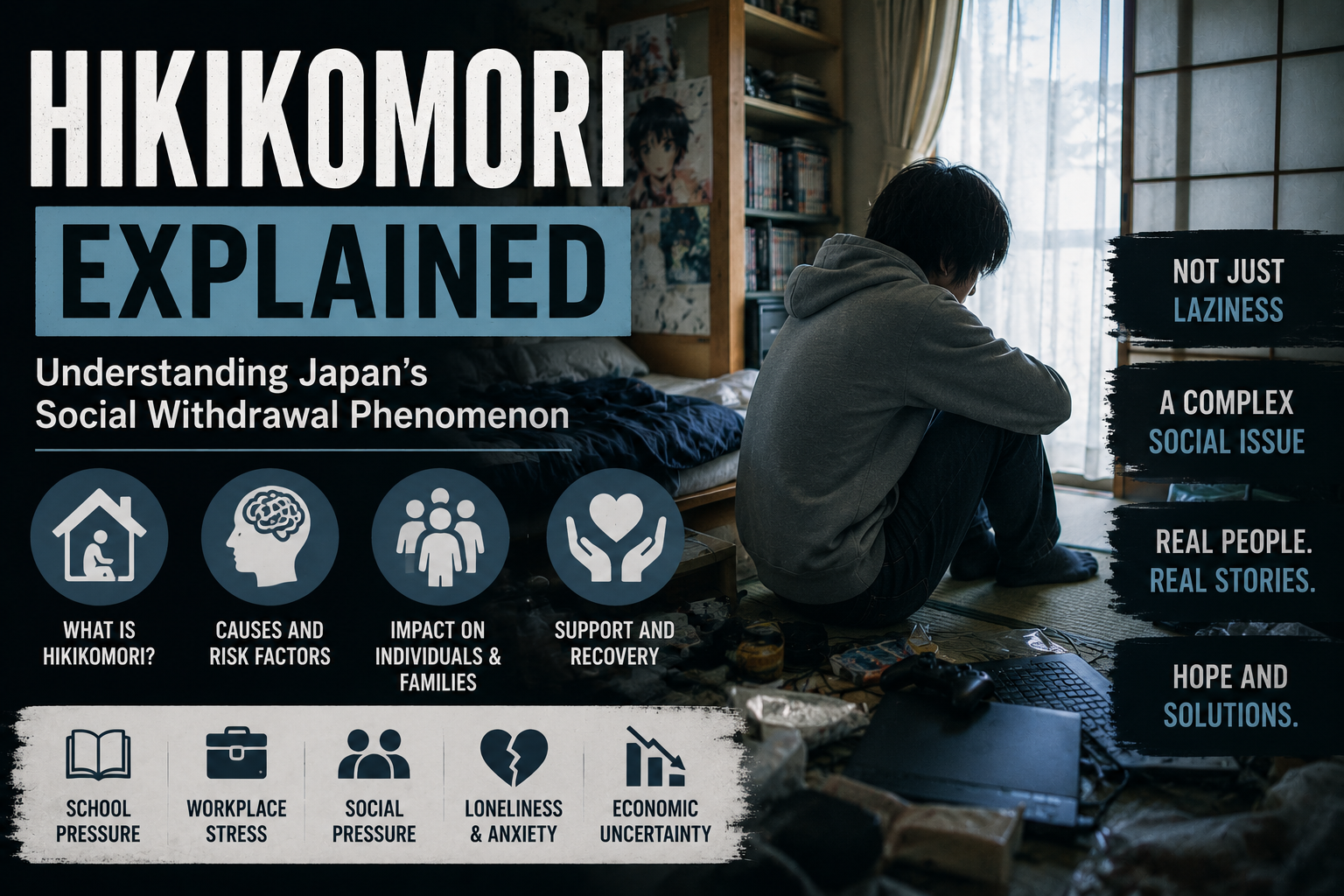
Hikikomori explained: this phrase has become increasingly popular as people around the world seek to understand one of Japan’s most misunderstood social phenomena.
Hikikomori refers to people who withdraw from society and remain isolated at home for extended periods, often for months or even years. While hikikomori is frequently associated with Japan, the issue is more complex than many stereotypes suggest.
In this article, we’ll explain what hikikomori is, why some Japanese people become hikikomori, and what this phenomenon reveals about modern Japanese society.
What Is Hikikomori?
The Japanese term hikikomori (ひきこもり) literally means “pulling inward” or “withdrawing.”
In Japan, the term generally refers to people who:
- Remain socially isolated for at least six months
- Rarely leave their homes
- Avoid work, school, and social relationships
- Have extremely limited interaction with society
Some hikikomori leave their rooms occasionally, while others may isolate themselves almost completely.
Importantly, hikikomori is not officially considered a specific mental illness. Instead, it describes a pattern of severe social withdrawal.
How Many Hikikomori Are There in Japan?
Estimating the number of hikikomori is difficult because many people remain hidden from public services.
Government surveys have suggested that hundreds of thousands of people in Japan may experience prolonged social withdrawal. Some researchers believe the actual number could be significantly higher.
Hikikomori affects:
- Teenagers
- Young adults
- Middle-aged adults
- Men and women
Although the phenomenon first gained public attention in the 1990s, many cases now involve adults in their 40s, 50s, and even older.
Why Do People Become Hikikomori?
There is no single cause of hikikomori.
Instead, experts believe that social withdrawal usually develops through a combination of psychological, social, economic, and cultural factors.
Academic Pressure and School Stress
For some people, hikikomori begins during childhood or adolescence.
Educational Pressure
Japanese students often experience intense pressure related to:
- School performance
- Entrance examinations
- University admissions
- Social expectations
- Future career success
Students who struggle academically or socially may begin avoiding school altogether.
Bullying and Social Isolation
Bullying, known in Japan as ijime, has also been linked to some cases of social withdrawal.
Experiences such as:
- School bullying
- Social exclusion
- Humiliation
- Academic failure
can contribute to long-term isolation.
Work Culture and Economic Pressure
For adults, work-related stress can become a major factor.
Pressure to Succeed
Japanese society traditionally places strong emphasis on:
- Stable employment
- Career achievement
- Financial independence
- Social contribution
Individuals who lose their jobs, fail to achieve career goals, or experience workplace problems may withdraw from society due to feelings of shame or failure.
Economic Insecurity
Economic uncertainty has increased for many younger generations.
Concerns about:
- Job security
- Income
- Housing
- Marriage
- Family expectations
can contribute to anxiety and social withdrawal.
Social Pressure and Fear of Judgment
Japanese culture places significant value on social harmony and meeting expectations.
Fear of Failure
Many people who become hikikomori report experiencing:
- Fear of criticism
- Fear of embarrassment
- Fear of disappointing others
- Fear of social rejection
When these pressures become overwhelming, withdrawal can feel safer than facing society.
The Pressure to Conform
In Japan, fitting into social groups is often highly valued.
People who feel different or unable to meet social expectations may gradually withdraw from social life altogether.
Is Hikikomori a Mental Illness?
Not necessarily.
Many hikikomori experience mental health conditions such as:
- Depression
- Anxiety disorders
- Social anxiety
- Autism spectrum disorders
- Trauma-related conditions
However, others do not meet the diagnostic criteria for any specific psychiatric disorder.
Experts increasingly view hikikomori as a complex social phenomenon that overlaps with mental health, family dynamics, economics, and culture.
Why Is Hikikomori Associated with Japan?
Hikikomori exists outside Japan as well, but Japan brought international attention to the phenomenon.
Several factors may explain why hikikomori became especially visible in Japan:
- Strong social expectations
- Intense educational competition
- Demanding work culture
- Family support systems
- Social stigma surrounding failure
In some cases, parents financially support their adult children for many years, allowing prolonged isolation to continue.
The “8050 Problem”
One of Japan’s growing social concerns is known as the “8050 problem.”
This term refers to situations where:
- Parents are in their 80s
- Their hikikomori children are in their 50s
As parents age, many families worry about who will support socially isolated adults in the future.
The 8050 problem highlights how hikikomori has become not only a personal issue, but also a broader social and economic challenge.
Can Hikikomori Recover?
Yes.
Many people who experience hikikomori eventually reconnect with society.
Support may include:
- Mental health treatment
- Counseling
- Family support
- Social programs
- Employment assistance
- Gradual social reintegration
Recovery often takes time, and there is no single solution that works for everyone.
Is Hikikomori Becoming More Common Worldwide?
Researchers have identified hikikomori-like social withdrawal in many countries, including:
- South Korea
- Italy
- Spain
- France
- the United States
The growth of remote work, online communities, and digital entertainment has led some experts to argue that severe social isolation is becoming a global issue rather than a uniquely Japanese one.
What Does Hikikomori Tell Us About Japan?
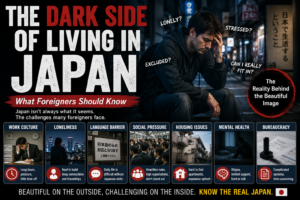
Hikikomori reflects some of the broader challenges facing modern Japan, including:
- Social pressure
- Economic insecurity
- Loneliness
- Mental health stigma
- Population aging
- Changing family structures
It also highlights the difficulties that some individuals face when navigating a highly structured society.
Conclusion
So, what is hikikomori?
Hikikomori is not simply laziness, shyness, or a uniquely Japanese problem. It is a complex form of social withdrawal influenced by psychological, social, economic, and cultural factors.
Understanding hikikomori helps us better understand not only modern Japan, but also the growing challenges of loneliness, mental health, and social isolation around the world.
FAQ
What does hikikomori mean?
Hikikomori is a Japanese term describing people who withdraw from society and remain socially isolated for extended periods.
Is hikikomori a mental illness?
No. Hikikomori itself is not considered a specific mental illness, although it often overlaps with mental health conditions.
How many hikikomori are there in Japan?
Estimates vary, but experts believe hundreds of thousands of people in Japan experience prolonged social withdrawal.
Can hikikomori recover?
Yes. Many people recover with appropriate social, family, and mental health support.
Does hikikomori only exist in Japan?
No. Similar forms of severe social withdrawal have been identified in many countries around the world.