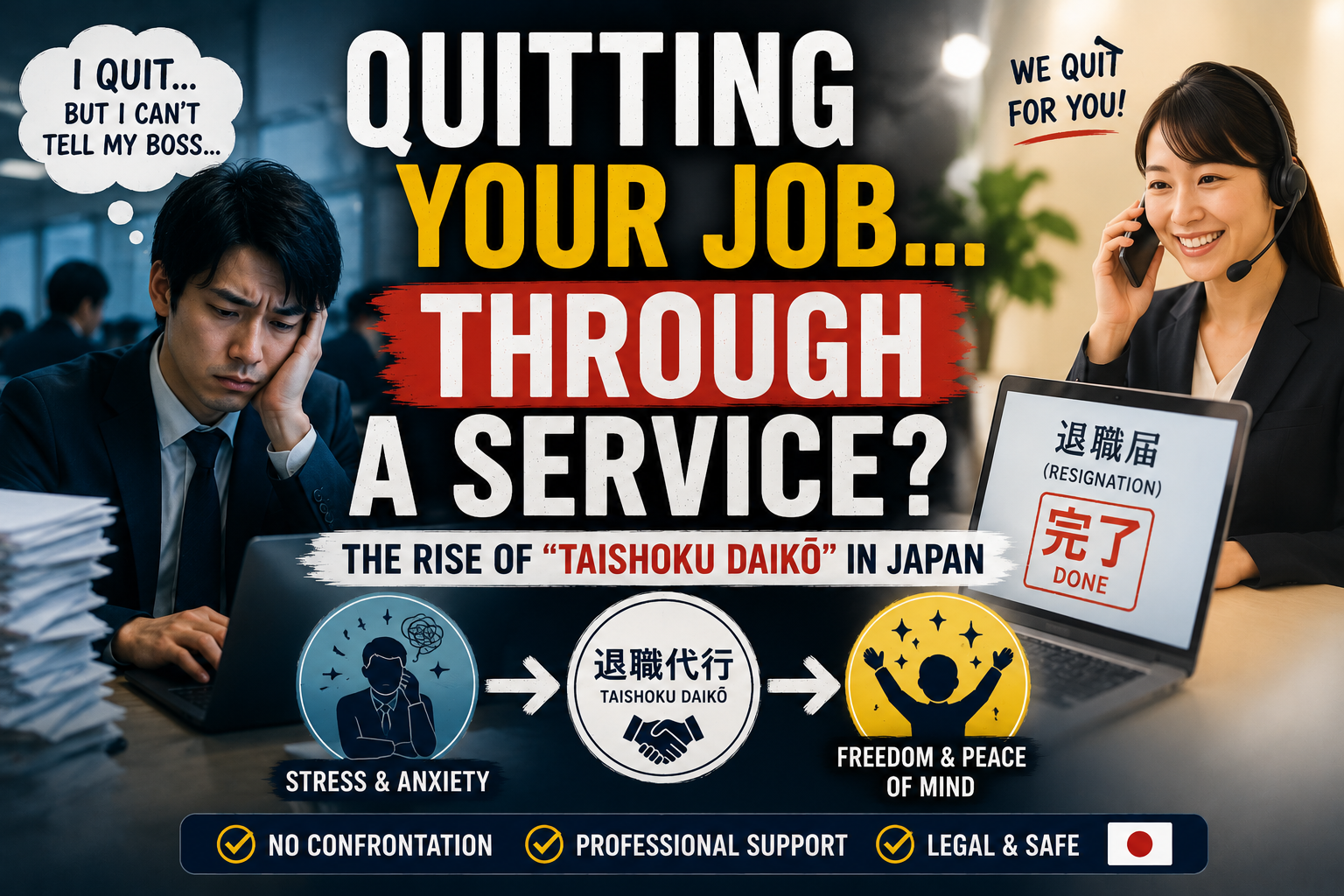
What Is “Taishoku Daikō”?
Imagine wanting to quit your job so badly that you hire a company to do it for you.
For many people outside Japan, that idea sounds unbelievable.
But in Japan, a growing number of workers are paying professional services to resign on their behalf.
These companies are called Taishoku Daikō (退職代行), which literally means “resignation agency” or “resignation proxy service.”
The rise of Taishoku Daikō has shocked many foreigners and sparked debate within Japan itself.
Why would someone pay a stranger to quit their job?
The answer reveals much more than workplace culture—it offers a glimpse into the pressures, expectations, and mental health challenges facing modern Japanese society.
What Is Taishoku Daikō?
Taishoku Daikō is a service that resigns from a job on behalf of a client.
Instead of telling their employer directly, customers pay a company to:
- Contact their employer
- Announce their resignation
- Explain that they will not return to work
- Handle communication during the resignation process
- Assist with paperwork and procedures
In some cases, services also cooperate with lawyers or labor specialists to help resolve disputes involving:
- Unpaid wages
- Harassment
- Illegal labor practices
- Workplace conflicts
The typical cost ranges from approximately:
- ¥20,000 to ¥30,000
- Around $130 to $200 USD
For many users, the price is worth avoiding a difficult confrontation.
Why Is Taishoku Daikō Becoming So Popular?
The popularity of resignation agencies reflects several broader trends in Japanese society.
Quitting Can Feel Like Betrayal
In many countries, resigning from a job is considered a normal career decision.
In Japan, however, traditional workplace culture often emphasizes:
- Loyalty
- Commitment
- Group harmony
- Respect for authority
Some employees feel that quitting means:
- Letting down their coworkers
- Betraying their company
- Creating trouble for others
As a result, simply saying “I quit” can become emotionally overwhelming.
Workplace Harassment Remains a Serious Problem
Another reason for the growth of Taishoku Daikō is workplace harassment.
Japan has specific terms for various forms of workplace abuse, including:
- Power harassment (pawa hara)
- Moral harassment
- Sexual harassment
Some employees report experiencing:
- Intimidation
- Verbal abuse
- Excessive pressure
- Threats
- Bullying by supervisors
For these workers, confronting their employer directly may feel impossible.
A resignation service provides a safer and less stressful alternative.
Younger Generations Think Differently About Work
Japan’s younger workers often have very different values from previous generations.
Many now prioritize:
- Mental health
- Work-life balance
- Personal freedom
- Happiness
- Self-care
Unlike older generations, many younger Japanese workers do not believe they should sacrifice their well-being for their employer.
As a result, using a resignation agency is increasingly viewed not as weakness, but as a practical solution.
Is Taishoku Daikō Legal?
Yes.
Under Japanese labor law, employees generally have the legal right to resign.
However, the legal details can vary depending on:
- Employment contracts
- Company rules
- Labor disputes
- Contract types
Most reputable Taishoku Daikō companies work carefully within Japanese labor law.
Some services also collaborate with attorneys to handle more complicated cases.
Because of this, the industry has become increasingly professionalized in recent years.
Why Does This Surprise Foreigners?
For many foreigners, paying someone else to quit a job seems unnecessary.
After all, in many Western countries, employees simply:
- Submit a resignation letter
- Speak with their manager
- Give notice
- Leave
But Japanese workplace culture often operates differently.
Factors such as:
- Respect for hierarchy
- Fear of confrontation
- Group pressure
- Social expectations
- Workplace loyalty
can make resignation feel emotionally difficult.
Taishoku Daikō exists because it solves a problem that many workers feel unable to solve themselves.
What Does Taishoku Daikō Reveal About Japanese Society?
The popularity of resignation agencies reveals several important realities about modern Japan:
Difficulty Saying “No”
Japanese culture often emphasizes:
- Avoiding conflict
- Maintaining harmony
- Respecting authority
This can make direct confrontation extremely stressful.
Fear of Disappointing Others
Many workers feel responsible not only for themselves but also for:
- Their coworkers
- Their supervisors
- Their company
- Their clients
This sense of responsibility can make quitting emotionally painful.
Growing Mental Health Awareness
The rise of Taishoku Daikō also reflects changing attitudes toward:
- Mental health
- Burnout
- Workplace stress
- Personal well-being
Increasingly, Japanese people are prioritizing their own health over traditional expectations.
Critics and Supporters
Not everyone agrees that resignation agencies are a good thing.
Critics argue that:
- Workers should resign personally.
- The services encourage avoidance.
- They weaken workplace responsibility.
- They undermine traditional values.
Supporters argue that:
- Employees have the right to protect themselves.
- Some workplaces are abusive.
- Mental health matters.
- Workers deserve safe ways to leave unhealthy environments.
The debate reflects broader changes happening throughout Japanese society.
Will Taishoku Daikō Continue to Grow?
Most experts believe the answer is yes.
Several factors suggest continued growth:
- Labor market changes
- Increased job mobility
- Greater mental health awareness
- Declining loyalty to employers
- Generational shifts
- Changing attitudes toward work
What once seemed shocking is gradually becoming normalized.
FAQ
What does Taishoku Daikō mean?
Taishoku Daikō (退職代行) means a resignation agency service that quits a job on behalf of a client.
How much does a resignation agency cost in Japan?
Most services charge between ¥20,000 and ¥30,000 (approximately $130–$200 USD).
Is using Taishoku Daikō legal?
Yes. Employees generally have the legal right to resign, and most reputable services operate legally.
Why do Japanese people use resignation agencies?
Common reasons include fear of confrontation, workplace harassment, social pressure, and concerns about mental health.
Is Taishoku Daikō becoming more popular?
Yes. The industry has grown significantly as attitudes toward work and mental health continue to change.