If you’ve spent time in Japan, dated a Japanese person, or worked for a Japanese company, you may have noticed something confusing: Do they avoid direct communication?
Japanese people often avoid saying exactly what they mean.
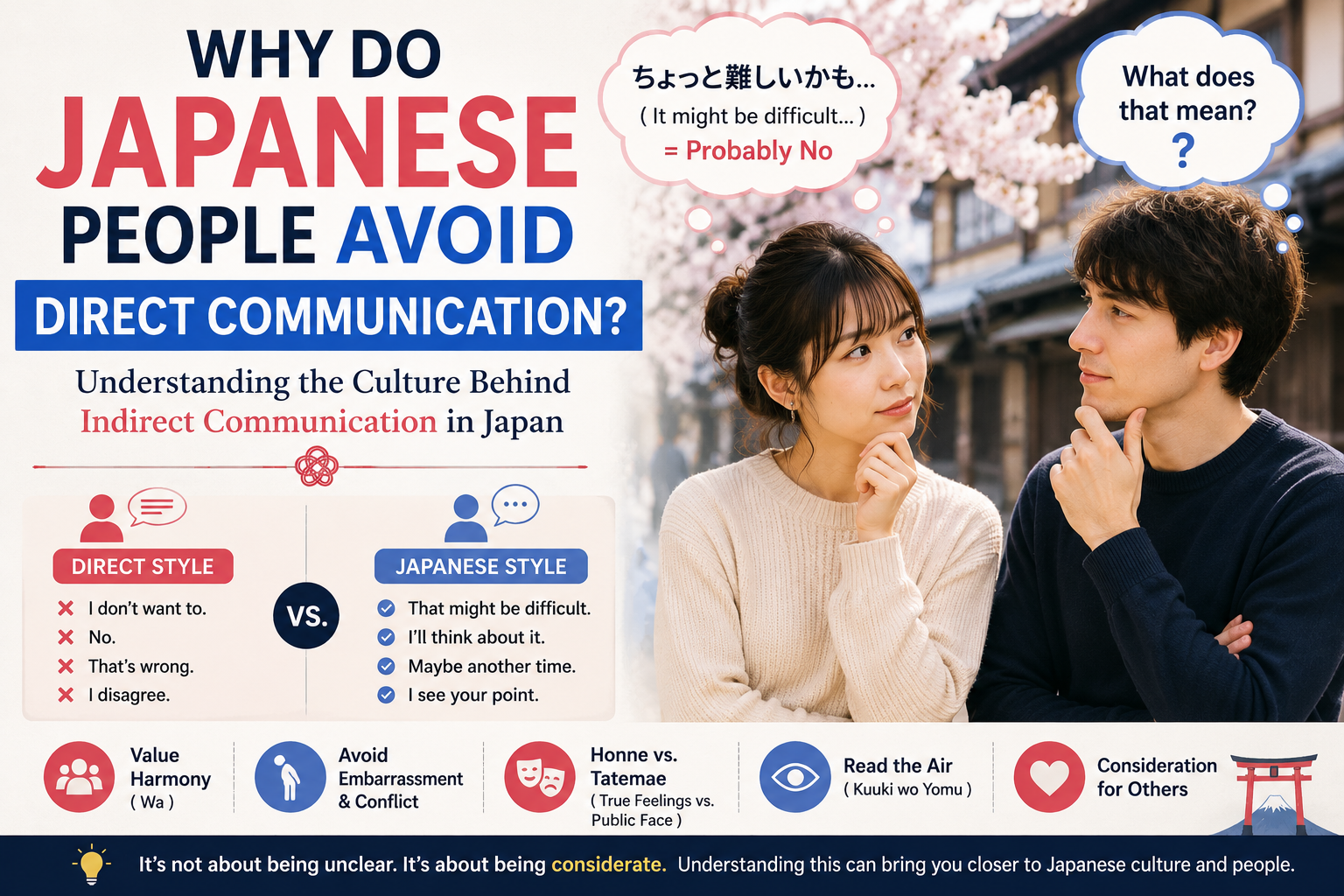
Instead of directly saying “no,” they may say:
- “That might be difficult.”
- “I’ll think about it.”
- “Maybe.”
- “We’ll see.”
- “It’s a little complicated.”
For many foreigners, this indirect communication style can feel frustrating, confusing, or even dishonest.
However, Japanese people generally do not avoid direct communication because they want to deceive others. Rather, indirect communication is deeply connected to Japanese cultural values such as harmony, politeness, and consideration for others.
Here’s why Japanese people often avoid direct communication and how to understand what they really mean.
The Importance of Harmony (Wa)
One of the most important concepts in Japanese society is wa (和), which means harmony.
Japanese culture traditionally places a strong emphasis on:
- Maintaining group harmony
- Avoiding conflict
- Preserving relationships
- Respecting social balance
- Preventing embarrassment
Direct communication can sometimes threaten social harmony because it may create tension, disagreement, or discomfort.
For this reason, many Japanese people prefer softer, indirect expressions.
For example:
Instead of saying:
“No, you’re wrong.”
A Japanese person may say:
“I’m not sure about that.”
“That’s one way to think about it.”
“Perhaps there is another perspective.”
The goal is often to protect the relationship rather than to win the argument.
Japanese Culture Is High-Context
Japan is considered a high-context culture.
In high-context cultures, people rely heavily on:
- Body language
- Tone of voice
- Social context
- Shared experiences
- Unspoken assumptions
In contrast, countries like the United States, Canada, Australia, and Germany are generally considered low-context cultures, where people prefer direct and explicit communication.
In Japan, people often expect others to “read the air,” a concept known as:
Kuuki wo yomu (空気を読む)
This means understanding the atmosphere and unspoken feelings of a situation.
As a result, many things remain unsaid.
Why Japanese People Rarely Say “No”
One of the biggest surprises for foreigners is that Japanese people often avoid saying “no” directly.
For example:
Direct:
“No, I don’t want to.”
Japanese indirect style:
- “That might be difficult.”
- “I’ll check my schedule.”
- “Maybe another time.”
- “I’ll think about it.”
In many cases, these phrases actually mean “no.”
Direct rejection can feel rude or embarrassing in Japanese culture, so indirect language allows both people to save face.
Avoiding Embarrassment and Shame
Japanese society traditionally places significant importance on avoiding embarrassment.
People often try to avoid:
- Embarrassing themselves
- Embarrassing others
- Public confrontation
- Social awkwardness
- Open criticism
For example, a Japanese boss may avoid criticizing an employee directly in front of others.
Likewise, a Japanese partner may avoid discussing relationship problems openly because they fear hurting the other person’s feelings.
This emphasis on emotional restraint influences communication in every aspect of Japanese society.
The Difference Between Honne and Tatemae
To understand Japanese communication, you need to understand two important concepts:
Honne (本音)
A person’s true feelings and opinions.
Tatemae (建前)
The public face or socially appropriate response.
For example:
A coworker may say:
“Your idea is interesting.”
But their private opinion may be:
“I don’t think this will work.”
This doesn’t necessarily mean they are lying. Rather, they are trying to maintain social harmony.
The balance between honne and tatemae is a fundamental part of Japanese communication.
Indirect Communication in Japanese Dating
Japanese dating culture is also highly indirect.
For example, instead of saying:
“I like you.”
Someone may say:
- “I enjoy spending time with you.”
- “I feel comfortable around you.”
- “Let’s meet again.”
- “You understand me.”
Similarly, rather than rejecting someone directly, they may say:
- “I’m busy.”
- “Maybe someday.”
- “I don’t know yet.”
This can be extremely confusing for foreigners who expect clear answers.
However, subtle communication is often considered more respectful in Japan.
Indirect Communication in Japanese Work Culture
Japanese workplaces often rely heavily on indirect communication.
Examples include:
Instead of:
“This report is bad.”
You might hear:
“Could we revise this part slightly?”
Instead of:
“You made a mistake.”
You might hear:
“There may have been a misunderstanding.”
Instead of:
“This project will fail.”
You might hear:
“There may be some challenges.”
This indirect approach helps preserve workplace relationships and hierarchy.
Why Foreigners Sometimes Misunderstand Japanese People
Many foreigners interpret indirect communication as:
- Dishonesty
- Lack of confidence
- Passive aggression
- Indecisiveness
However, Japanese people often interpret excessive directness as:
- Aggressive
- Selfish
- Impolite
- Insensitive
Neither approach is inherently right or wrong.
They simply reflect different cultural values.
Does This Mean Japanese People Never Speak Directly?
No.
Japanese people can be very direct in certain situations, including:
- Emergencies
- Family discussions
- Close friendships
- Romantic relationships
- Professional expertise
- Serious conflicts
However, compared to many Western cultures, indirect communication remains the default approach.
How Foreigners Should Communicate in Japan
If you live, work, or date in Japan, consider these tips:
Listen Beyond the Words
Pay attention to:
- Tone of voice
- Facial expressions
- Timing
- Hesitation
- Body language
Don’t Expect Immediate Answers
Japanese people often prefer time to think before responding.
Avoid Public Confrontation
Criticism is generally better received privately.
Learn Common Indirect Expressions
Examples include:
- “It’s difficult.” = Probably no.
- “I’ll think about it.” = Often no.
- “Maybe.” = Possibly no.
- “We’ll see.” = Usually uncertain.
- “Not impossible.” = Maybe yes.
Be Patient
Building trust often leads to more honest and direct communication over time.
Is Japanese Communication Changing?
Yes.
Younger generations are becoming somewhat more direct due to:
- Social media
- International travel
- Foreign influence
- Global business culture
- Dating apps
However, traditional values such as harmony and consideration remain deeply important.
Most experts believe Japanese communication will continue to balance both direct and indirect styles.
Final Thoughts
Japanese people avoid direct communication not because they are dishonest, but because they prioritize:
- Harmony
- Respect
- Empathy
- Social balance
- Emotional consideration
Understanding indirect communication can help you build better relationships in Japan, whether in dating, friendship, or business.
In many ways, Japanese communication asks an important question:
“How can I express myself without hurting someone else?”
And for many Japanese people, that question matters more than simply saying exactly what they think.
FAQ
Why do Japanese people avoid saying no?
Many Japanese people avoid direct rejection to preserve harmony and avoid embarrassing others.
What does “reading the air” mean in Japan?
“Reading the air” (kuuki wo yomu) means understanding unspoken social cues and the emotional atmosphere.
Are Japanese people passive-aggressive?
Not necessarily. Indirect communication is often intended to be polite and considerate rather than aggressive.
Why do Japanese people say “maybe” so often?
“Maybe” can serve as a softer alternative to direct disagreement or rejection.
Is Japanese communication becoming more direct?
Younger generations are becoming somewhat more direct, but indirect communication remains an important part of Japanese culture.