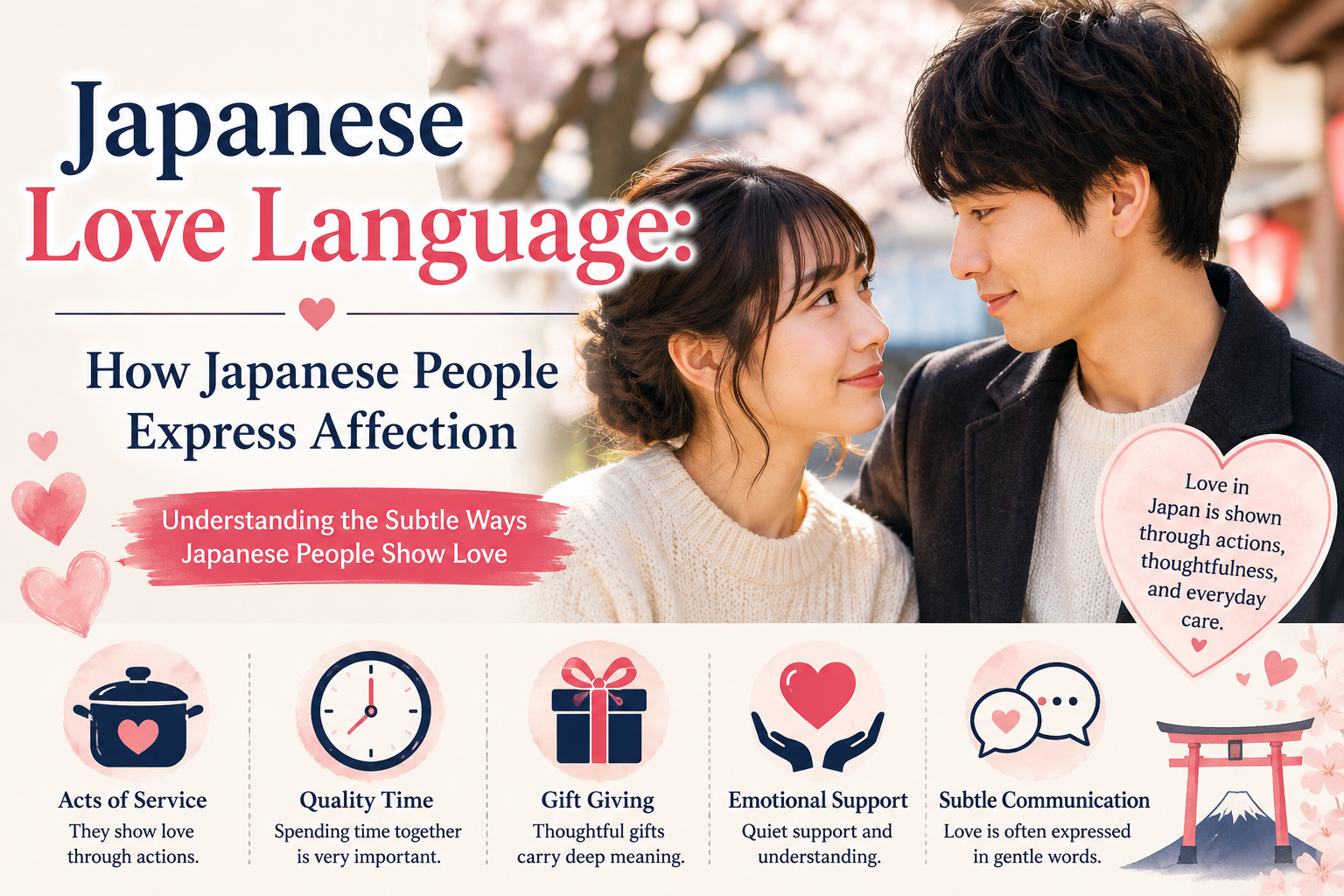
If you’re dating a Japanese person or interested in Japanese dating culture, you may have noticed something surprising: many Japanese people don’t say “I love you” very often.
This doesn’t mean they are less romantic. In fact, Japanese people often express affection in ways that are much more subtle than what many Westerners are used to.
Understanding the Japanese love language can help you avoid misunderstandings, build stronger relationships, and better appreciate Japanese culture.
Here’s how Japanese people typically express love and affection.
Do Japanese People Say “I Love You”?
Compared to Western countries, Japanese people generally say “I love you” less frequently.
The Japanese phrase “Aishiteru” (愛してる) is considered extremely serious and emotionally powerful. Many couples may never use it regularly, even after years together.
Instead, Japanese people often prefer softer expressions, such as:
- “Suki” (好き) — “I like you”
- “Daisuki” (大好き) — “I really like you”
- “Itsumo arigatou” (いつもありがとう) — “Thank you, as always”
- “Ki wo tsukete” (気をつけて) — “Take care”
For many Japanese people, actions communicate love more effectively than words.
Acts of Service: Japan’s Most Common Love Language
One of the most common ways Japanese people express affection is through acts of service.
Examples include:
- Cooking your favorite meals
- Helping you with daily tasks
- Picking you up from the station
- Taking care of you when you’re sick
- Remembering small details about your preferences
- Supporting your goals and career
A Japanese partner may rarely say “I love you,” but they might wake up early every morning to prepare your lunch.
In Japanese culture, caring actions often speak louder than romantic words.
Quality Time Is Extremely Important
Japanese couples often prioritize spending quality time together.
This may include:
- Going on seasonal dates
- Traveling together
- Watching TV at home
- Visiting cafes
- Walking together after dinner
- Sharing hobbies
Physical affection in public may be limited, but emotional closeness through shared experiences is highly valued.
Many Japanese couples believe that simply spending time together is an expression of love itself.
Remembering Small Details
Japanese people often express affection by paying attention to details.
For example, they may remember:
- Your favorite food
- Your coffee order
- Important dates
- Your hobbies
- Things you casually mentioned months ago
- Your work schedule
To many Japanese people, remembering these details demonstrates care, attentiveness, and emotional investment.
Gift Giving as an Expression of Love
Gift giving plays a major role in Japanese relationships.
Unlike some Western cultures where gifts are reserved for special occasions, Japanese people often exchange small gifts throughout the year.
Examples include:
- Souvenirs from trips (omiyage)
- Seasonal sweets
- Birthday presents
- White Day gifts
- Christmas gifts
- Handmade items
The value of the gift is often less important than the thought and effort behind it.
A small souvenir purchased during a trip may carry more emotional meaning than an expensive luxury item.
Taking Care of You When You’re Sick
One classic sign of affection in Japan is caring for someone when they are sick.
A Japanese partner may:
- Bring medicine
- Prepare porridge (okayu)
- Buy groceries
- Check on you frequently
- Visit you after work
- Help with household tasks
For many Japanese people, this type of care represents one of the deepest forms of love.
Quiet Emotional Support
Japanese communication tends to be less emotionally expressive than in some Western cultures.
Instead of saying:
“I believe in you.”
A Japanese partner may:
- Stay up late helping you prepare
- Listen quietly when you’re stressed
- Offer practical advice
- Support your decisions
- Encourage you through actions
This quiet support is often viewed as a powerful expression of affection.
Physical Affection in Japan
Physical affection varies significantly among couples.
Generally speaking:
In Public
Many Japanese couples avoid:
- Kissing
- Hugging
- Excessive touching
Public displays of affection remain relatively modest compared to many Western countries.
In Private
In private, Japanese couples may become much more affectionate through:
- Hugging
- Cuddling
- Holding hands
- Physical closeness
- Sleeping together
The contrast between public and private affection often surprises foreigners.
Love Through Everyday Routine
One unique aspect of Japanese love language is consistency.
Examples include:
- Sending a “good morning” message every day
- Asking if you arrived home safely
- Saying “otsukaresama” after work
- Preparing meals regularly
- Walking you to the train station
- Waiting for you after work
These routines create emotional security and intimacy.
In Japan, love is often expressed through reliability rather than dramatic gestures.
Why Japanese People Can Seem Emotionally Distant
Many foreigners initially believe Japanese people are emotionally cold.
In reality, Japanese culture generally values:
- Modesty
- Emotional control
- Indirect communication
- Harmony
- Consideration for others
Showing excessive emotion publicly can sometimes feel uncomfortable.
As a result, affection may appear subtle even when feelings are very strong.
The Biggest Mistake Foreigners Make
The biggest mistake is judging Japanese affection by Western standards.
For example, you might think:
- “She never says I love you.”
- “He doesn’t compliment me.”
- “She doesn’t show enough emotion.”
However, your Japanese partner may be expressing love through:
- Cooking for you
- Making time for you
- Supporting you financially
- Remembering details
- Helping you every day
Understanding these cultural differences can prevent unnecessary misunderstandings.
What Is the Japanese Love Language Equivalent to the Five Love Languages?
If we compare Japanese dating culture to the popular Five Love Languages theory, Japanese people often emphasize:
1. Acts of Service
The strongest and most common expression of affection.
2. Quality Time
Sharing experiences together.
3. Gift Giving
Thoughtful gifts and souvenirs.
4. Physical Touch
Usually expressed more privately.
5. Words of Affirmation
Generally less emphasized than in Western cultures.
Of course, every individual is different, but these trends are commonly observed in Japanese relationships.
Final Thoughts
Japanese people absolutely express love and affection—they simply do it differently.
Rather than grand romantic speeches, many Japanese people communicate love through:
- Daily actions
- Reliability
- Consideration
- Quality time
- Emotional support
- Thoughtful gestures
If you’re dating a Japanese partner, paying attention to these subtle signs can help you understand their feelings more clearly.
In Japan, love is often something that is shown, not said.
FAQ
What is the Japanese love language?
Japanese love language often emphasizes acts of service, quality time, gift giving, and subtle emotional support rather than direct verbal expressions.
Do Japanese people say “I love you”?
Yes, but less frequently than in many Western countries. Expressions like “suki” are more commonly used.
Why don’t Japanese people show affection publicly?
Japanese culture traditionally values modesty and privacy, making public displays of affection less common.
How do Japanese women express love?
Japanese women often express love through care, emotional support, remembering details, gift giving, and spending quality time together.
How do Japanese men show affection?
Japanese men often express affection through reliability, practical support, acts of service, and commitment rather than verbal declarations.