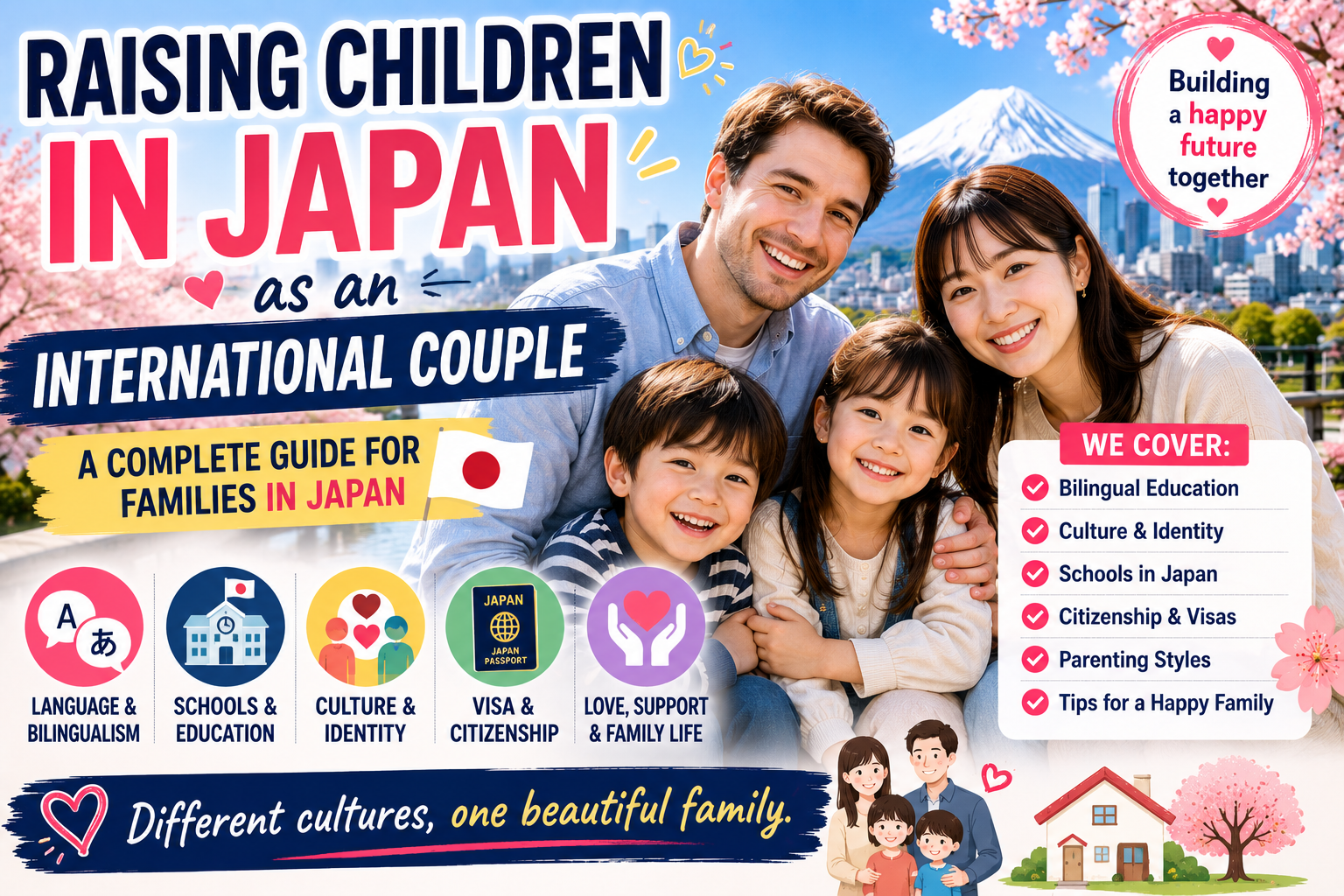
For many international couples living in Japan, raising children eventually becomes very important.
Japan is often considered one of the safest countries in the world to raise a family. It offers excellent healthcare, strong educational systems, and family-oriented communities.
At the same time, raising children as an international couple can present unique challenges that Japanese families may never face.
Questions about language, culture, identity, education, and family expectations often become part of everyday life.
If you’re planning a future with your Japanese partner, here’s what you should know.
Is Japan a Good Country to Raise Children?
For many families, the answer is yes.
Japan offers several advantages, including:
- Low crime rates
- High-quality healthcare
- Excellent public transportation
- Safe neighborhoods
- Strong educational standards
- Long life expectancy
- Family-friendly communities
Many international parents appreciate the sense of safety and stability that Japan provides.
Children in Japan often enjoy a high degree of independence from a young age.
Will Your Child Be Bilingual?
Many international couples hope to raise bilingual children.
The good news is that bilingualism is absolutely possible.
However, it usually requires intentional effort.
Many experts recommend the:
One Parent, One Language (OPOL) Method
For example:
- One parent consistently speaks English.
- The other parent consistently speaks Japanese.
This approach helps children naturally associate each language with a specific parent.
Consistency is often more important than perfection.
Why Do Some Children Lose Their Second Language?
One challenge international families face is language dominance.
Because children in Japan spend most of their time using Japanese:
- At school
- With friends
- In society
- Through media
Japanese often becomes their strongest language.
Without continued exposure, children may gradually lose confidence in their second language.
Parents often maintain bilingualism through:
- Speaking the minority language at home
- Reading books together
- Watching media in both languages
- Visiting family abroad
- Weekend language schools
Which Nationality Will Your Child Have?
Nationality laws depend on both countries involved.
Children born to international couples often qualify for:
- Japanese nationality
- Their foreign parent’s nationality
- Dual nationality (at least temporarily)
Japan’s nationality laws can be complex.
Because regulations differ by country, parents should verify:
- Citizenship eligibility
- Passport requirements
- Registration procedures
- Future nationality options
Planning early can prevent legal complications later.
Should You Send Your Child to Japanese Public School?
Many international families choose Japanese public schools.
Advantages include:
- Strong academic standards
- Low cost
- Social integration
- Japanese language fluency
- Community involvement
Japanese schools also teach important values such as:
- Cooperation
- Responsibility
- Respect
- Group harmony
For many families, public school becomes an important part of cultural integration.
What About International Schools?
Some parents choose international schools instead.
Possible reasons include:
- English-language education
- International curriculum
- Easier overseas university admission
- Multicultural environment
- Greater educational flexibility
However, international schools often involve:
- High tuition costs
- Competitive admissions
- Longer commuting distances
There is no universally correct choice.
The best decision depends on each family’s goals.
Helping Children Develop a Bicultural Identity
Many international parents worry about questions such as:
- “Am I Japanese?”
- “Am I foreign?”
- “Where do I belong?”
These questions are completely normal.
Children raised in international families often develop:
- Multiple cultural identities
- Flexible perspectives
- Strong intercultural skills
- Global awareness
Rather than forcing a single identity, many successful families encourage children to embrace both cultures.
Family Expectations Can Be Different
International couples often discover differences in parenting philosophy.
Examples include:
Japanese Parenting
May emphasize:
- Group harmony
- Independence
- Responsibility
- Academic effort
- Social cooperation
Western Parenting
May emphasize:
- Individual expression
- Emotional communication
- Creativity
- Personal choice
- Self-confidence
Neither approach is inherently better.
Successful families often combine elements of both cultures.
Grandparents Can Play an Important Role
In many Japanese families, grandparents remain closely involved.
They may help with:
- Childcare
- School events
- Family traditions
- Emotional support
For international families, grandparents can also help children maintain strong connections to Japanese culture.
At the same time, balancing relationships with relatives abroad may require additional effort.
Education Pressure in Japan
One aspect that surprises many foreign parents is the importance placed on education.
Children may experience pressure related to:
- Entrance examinations
- Academic performance
- After-school lessons (juku)
- Extracurricular activities
- University admissions
Not every family follows the same approach, but educational expectations can be an important topic for international couples to discuss.
Challenges International Families Often Face
Raising children in Japan as an international couple can present unique challenges.
These may include:
- Language barriers
- Identity questions
- Different parenting styles
- Educational choices
- Immigration issues
- Cultural misunderstandings
- Distance from overseas relatives
These challenges are normal and can usually be managed through communication and planning.
Advantages of Raising Bicultural Children
Many parents believe the advantages outweigh the challenges.
Children raised in international families often develop:
- Bilingual abilities
- Cultural flexibility
- Adaptability
- Global perspectives
- Empathy
- Communication skills
These qualities can become lifelong strengths.
What Foreign Parents Often Misunderstand
Foreign parents sometimes assume:
“My child will become automatically bilingual.”
Bilingualism usually requires consistent effort.
“My child must choose one culture.”
Many children successfully embrace multiple identities.
“Japanese schools are too strict.”
While Japanese schools emphasize structure, many children thrive within that environment.
Final Thoughts
Raising children in Japan as an international couple can be both challenging and incredibly rewarding.
Your family may navigate:
- Multiple languages
- Multiple cultures
- Different traditions
- Different expectations
But these experiences can also provide your children with unique opportunities and perspectives.
The goal isn’t to choose between cultures.
The goal is to help your children feel that both cultures belong to them.
And for many international families in Japan, that’s one of the greatest gifts they can offer their children.
FAQ
Can children of international couples become bilingual in Japan?
Yes. However, maintaining bilingual ability usually requires consistent exposure to both languages.
Can a child have Japanese and foreign nationality?
In many cases, yes, although nationality laws vary depending on the countries involved.
Are Japanese public schools good for international children?
Many international families choose Japanese public schools because of their quality and affordability.
Should international couples choose international schools?
It depends on family goals, finances, language priorities, and future educational plans.
Is Japan a good place to raise children?
Many families consider Japan one of the safest and most family-friendly countries in the world.