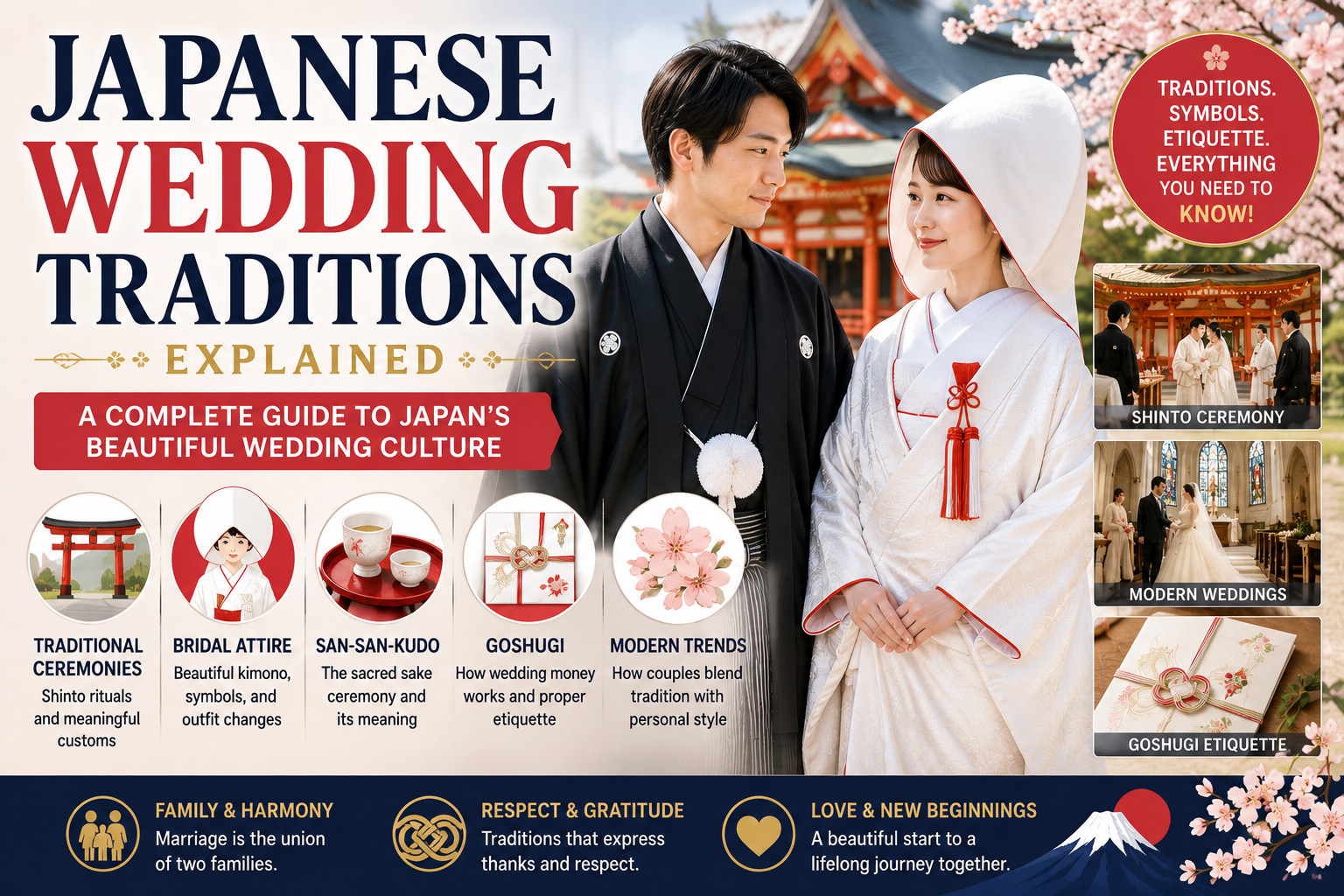
Japanese wedding is often seen as elegant, traditional, and highly symbolic.
However, many foreigners are surprised to discover that modern Japanese weddings are actually a fascinating blend of:
- Traditional Japanese customs
- Western influences
- Religious symbolism
- Modern trends
Whether you’re attending a Japanese wedding, marrying a Japanese partner, or simply curious about Japanese culture, understanding Japanese wedding traditions can help you appreciate one of Japan’s most important life events.
Here’s everything you need to know.
Are Japanese Weddings Religious?
Unlike many countries, Japanese weddings often combine multiple religious traditions.
A Japanese person may:
- Have a Shinto wedding ceremony
- Celebrate Christmas
- Visit Buddhist temples
- Participate in secular traditions
For many Japanese people, weddings are viewed as both cultural and personal events rather than strictly religious ones.
The three most common wedding styles in Japan are:
- Shinto weddings
- Christian-style weddings
- Modern secular weddings
Traditional Shinto Weddings
When foreigners imagine a Japanese wedding, they often picture a traditional Shinto ceremony.
These weddings usually take place at:
- Shinto shrines
- Traditional hotels
- Historic venues
Shinto weddings emphasize:
- Family
- Purity
- Harmony
- Tradition
- Spiritual blessings
Although not all Japanese couples choose Shinto weddings today, they remain highly symbolic and culturally important.
The Bride’s Traditional Wedding Attire
One of the most famous Japanese wedding traditions is the bride’s clothing.
Traditional bridal outfits include:
Shiromuku (白無垢)
A completely white kimono symbolizing:
- Purity
- New beginnings
- Commitment to a new family
The bride often wears:
- White kimono
- White hood (tsunokakushi)
- Traditional hairstyle
- Elegant accessories
The visual appearance is one of the most iconic images of Japanese culture.
Iro-uchikake (色打掛)
Many brides later change into a colorful embroidered kimono.
These garments often feature:
- Cranes
- Cherry blossoms
- Gold embroidery
- Seasonal symbols
Multiple outfit changes during weddings are common in Japan.
What Does the Groom Wear?
In traditional ceremonies, the groom often wears:
Montsuki Haori Hakama (紋付羽織袴)
This formal attire includes:
- A black kimono
- Family crest
- Traditional jacket
- Hakama trousers
In modern weddings, many grooms wear Western-style tuxedos instead.
The San-San-Kudo Ceremony
One of the most important Shinto wedding rituals is:
San-San-Kudo (三三九度)
This ceremony involves the bride and groom sharing sake from three cups.
The ritual symbolizes:
- Union between the couple
- Unity between families
- Commitment and harmony
The number nine is traditionally considered auspicious in Japanese culture.
For many couples, this remains the emotional centerpiece of the ceremony.
Why Do So Many Japanese Weddings Look Christian?
One surprising fact about Japan is that many couples choose Christian-style weddings despite Christianity being a minority religion.
These weddings often feature:
- Wedding dresses
- Tuxedos
- Church buildings
- Organ music
- Wedding vows
- White flowers
In many cases:
- The church is a wedding venue.
- The officiant may not be a priest.
- The ceremony is symbolic rather than religious.
Many Japanese couples simply enjoy the aesthetic and romantic atmosphere.
Wedding Receptions Are Extremely Important
After the ceremony comes:
Kekkon Hiroen (結婚披露宴)
The wedding reception.
Japanese wedding receptions are often:
- Formal
- Carefully planned
- Structured
- Family-oriented
Typical activities include:
- Speeches
- Video presentations
- Toasts
- Cake cutting
- Entertainment
- Family introductions
Unlike some Western weddings, Japanese receptions often follow a detailed schedule.
Why Do Japanese Brides Change Clothes Multiple Times?
Many Japanese brides change outfits several times during the wedding.
For example:
- Traditional white kimono
- Colorful kimono
- Western wedding dress
- Evening dress
These costume changes are known as:
Oironaoshi (お色直し)
The outfit changes symbolize:
- New beginnings
- Celebration
- Different aspects of identity
Guests often look forward to each costume change.
What Is Goshugi (Wedding Money)?
One of the most important Japanese wedding customs is:
Goshugi (ご祝儀)
Instead of bringing physical gifts, guests usually give money.
Typical amounts include:
- ¥30,000 for friends
- ¥50,000 or more for relatives
- Higher amounts for close family
Special decorative envelopes called:
Shugi-bukuro (祝儀袋)
are used.
Interestingly, odd-numbered amounts are generally preferred because they cannot be divided evenly.
Japanese Wedding Speeches
Wedding speeches remain an important tradition.
Speakers may include:
- Parents
- Friends
- Coworkers
- Supervisors
- The couple themselves
Common themes include:
- Gratitude
- Family
- Future happiness
- Support
- Shared memories
Formal speeches are often prepared very carefully.
Family Plays an Important Role
Japanese weddings traditionally emphasize not only the couple but also the joining of two families.
This can include:
- Formal family introductions
- Family seating arrangements
- Respect for elders
- Family photographs
- Ceremonial acknowledgments
For many Japanese people, marriage is viewed as a union between families as much as between individuals.
Modern Japanese Weddings Are Changing
Today’s couples increasingly personalize their weddings.
Modern trends include:
- Destination weddings
- Smaller ceremonies
- International weddings
- Outdoor weddings
- Casual receptions
- Customized celebrations
Many younger couples combine:
- Japanese traditions
- Western customs
- Personal preferences
The result is often a unique hybrid celebration.
What Foreign Guests Should Know
If you’re invited to a Japanese wedding:
Dress Formally
Business attire or formal wear is usually expected.
Bring Goshugi
Cash gifts are standard.
Arrive On Time
Punctuality is extremely important.
Expect Structure
Japanese weddings are often more organized than Western weddings.
Respect Traditions
Even if customs seem unfamiliar, showing respect is appreciated.
The Biggest Misconception About Japanese Weddings
Many foreigners believe Japanese weddings are entirely traditional.
In reality, modern Japanese weddings are often a blend of:
- Japanese culture
- Western traditions
- Family expectations
- Personal preferences
This combination is part of what makes Japanese weddings so unique.
Final Thoughts
Japanese wedding traditions beautifully combine:
- History
- Family
- Romance
- Ceremony
- Modern culture
Whether held at a shrine, a hotel, or a chapel, Japanese weddings often emphasize:
- Respect
- Harmony
- Commitment
- Family bonds
- Shared futures
At their core, Japanese weddings are not only celebrations of love.
They are celebrations of connection, tradition, and the beginning of a new chapter in life.
FAQ
What is a traditional Japanese wedding called?
A traditional Japanese wedding is often called a Shinto wedding or Shinzen Shiki (神前式).
Why do Japanese couples have Christian weddings?
Many Japanese couples enjoy the romantic atmosphere and aesthetic of Christian-style ceremonies.
How much money should guests give at a Japanese wedding?
Many guests give around ¥30,000, although the amount varies depending on the relationship.
Why do Japanese brides change clothes multiple times?
Multiple outfit changes symbolize celebration, tradition, and new beginnings.
Are Japanese weddings religious?
Some are religious, but many modern Japanese weddings are cultural or symbolic rather than strictly religious.