If you’ve studied Japanese—or even just traveled to Japan—you’ve probably heard people talk about keigo (敬語).
For many foreigners, keigo is one of the most confusing parts of learning Japanese.
After all, why does one language need so many different ways to say the same thing?
The answer lies not only in grammar but also in Japanese culture itself.
Keigo is much more than a collection of polite expressions. It reflects how Japanese people think about:
- Respect
- Hierarchy
- Social relationships
- Humility
- Communication
Understanding keigo can help you understand not only the Japanese language, but Japanese society as a whole.
What Is Keigo?
Keigo (敬語) literally means:
“respectful language.”
It is the system of speech used in Japanese to express:
- Politeness
- Respect
- Humility
- Social awareness
Unlike English, where politeness is often shown through word choice or tone, Japanese incorporates politeness directly into grammar and vocabulary.
In simple terms:
How you say something can be just as important as what you say.
Why Does Japanese Have Keigo?
Keigo developed over centuries as Japanese society became increasingly structured and hierarchical.
Traditional Japanese culture places strong importance on:
- Social harmony
- Respect for elders
- Status relationships
- Group membership
- Humility
As a result, language evolved to reflect these social relationships.
Even today, the way Japanese people speak often changes depending on:
- Age
- Job position
- Social status
- Familiarity
- Context
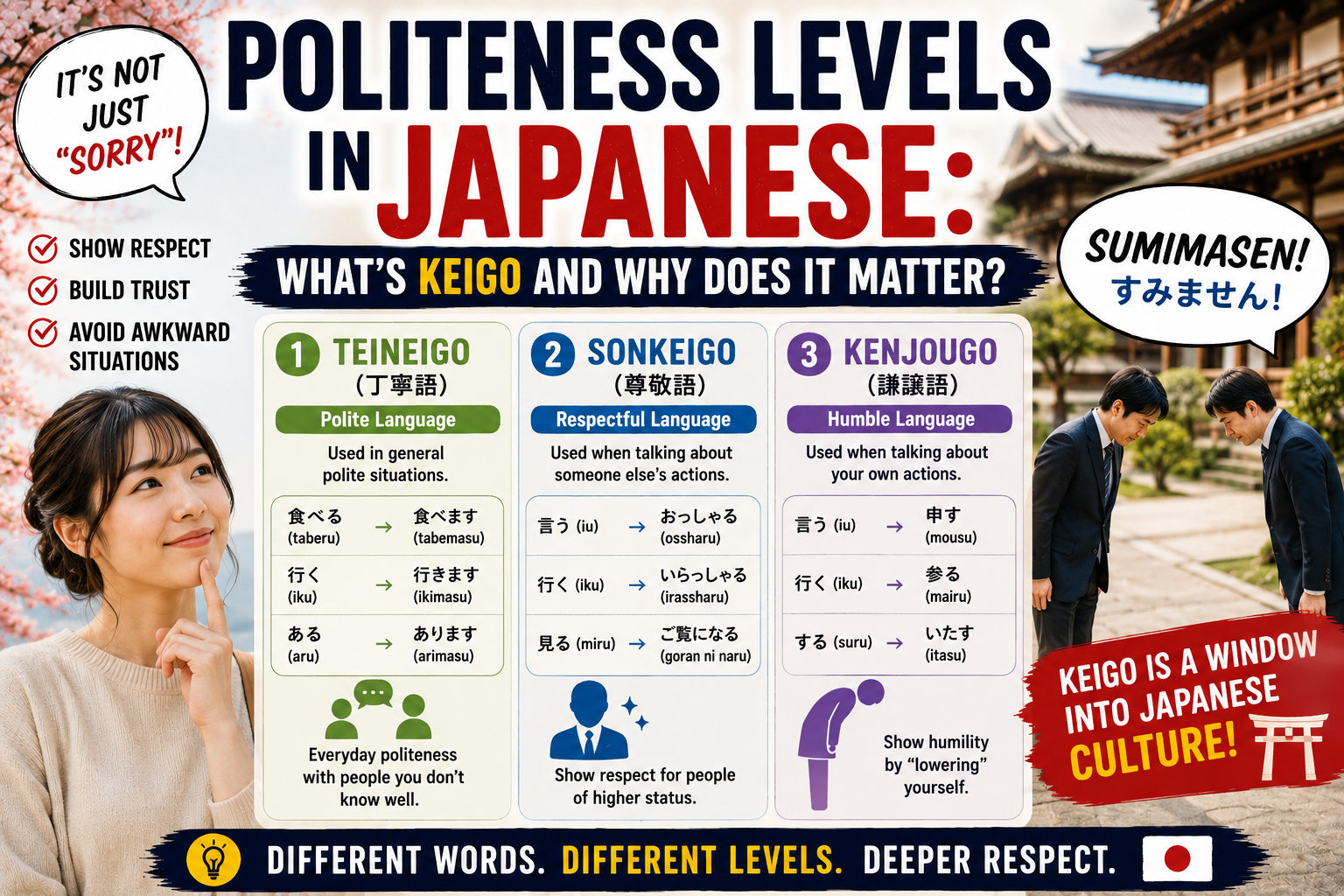
The Three Main Types of Keigo
Japanese polite speech is usually divided into three categories.
Teineigo (丁寧語): Polite Language
This is the type of Japanese most learners study first.
Teineigo is used to speak politely with people you don’t know well.
Examples:
| Casual | Polite (Teineigo) | Meaning |
|---|---|---|
| 食べる (taberu) | 食べます (tabemasu) | To eat |
| 行く (iku) | 行きます (ikimasu) | To go |
| ある (aru) | あります (arimasu) | To exist |
When is it used?
- Speaking with strangers
- Customer service
- School
- Work
- Everyday polite conversation
For travelers and most foreign residents, learning this level is usually enough.
Sonkeigo (尊敬語): Respectful Language
Sonkeigo is used when talking about someone else’s actions, especially someone of higher status.
Examples:
| Standard | Sonkeigo | Meaning |
|---|---|---|
| 言う (iu) | おっしゃる (ossharu) | To say |
| 行く (iku) | いらっしゃる (irassharu) | To go |
| 見る (miru) | ご覧になる (goran ni naru) | To see |
When is it used?
- Talking to customers
- Speaking with supervisors
- Referring to teachers
- Addressing elders
- Formal business situations
The purpose is to elevate the other person.
Kenjougo (謙譲語): Humble Language
Kenjougo works in the opposite way.
Instead of elevating the other person, you lower yourself.
Examples:
| Standard | Kenjougo | Meaning |
|---|---|---|
| 言う (iu) | 申す (mousu) | To say |
| 行く (iku) | 参る (mairu) | To go |
| する (suru) | いたす (itasu) | To do |
When is it used?
- Customer service
- Business settings
- Formal introductions
- Professional communication
The purpose is to show humility and respect.
Why Does Keigo Feel So Difficult?
Many foreigners feel overwhelmed by keigo because there are often multiple ways to say exactly the same thing.
For example, the simple verb:
“to go”
can become:
- 行く (iku)
- 行きます (ikimasu)
- いらっしゃる (irassharu)
- 参る (mairu)
The correct choice depends entirely on:
- Who is speaking
- Who is listening
- Who is being discussed
- The social relationship between them
In other words, grammar alone isn’t enough—you also need to understand social context.
Even Japanese People Struggle With Keigo
Here’s a secret that surprises many foreigners:
Many Japanese people also find keigo difficult.
In fact:
- Young employees often receive keigo training.
- Companies teach business keigo.
- Native speakers sometimes make mistakes.
- Certain forms remain controversial even among Japanese people.
Using perfect keigo is difficult even for native speakers.
Do Tourists Need to Learn Keigo?
Fortunately, the answer is:
No.
If you’re visiting Japan as a tourist, basic polite Japanese is more than enough.
The simple desu/masu form will work in almost every situation.
For example:
- ありがとうございます (Thank you)
- すみません (Excuse me)
- お願いします (Please)
These expressions already sound polite and respectful.
When Does Keigo Become Important?
Keigo becomes more important if you:
- Work in Japan
- Study Japanese seriously
- Work in customer service
- Conduct business in Japanese
- Interact professionally with Japanese clients
In these situations, using appropriate levels of politeness can affect how others perceive you.
What Does Keigo Reveal About Japanese Culture?
Keigo reflects several important Japanese values:
- Respect for others
- Awareness of social roles
- Humility
- Group harmony
- Consideration
Rather than simply communicating information, Japanese communication often emphasizes maintaining good relationships.
This is one reason why many foreigners find Japanese culture both fascinating and challenging.
FAQ
What does keigo mean?
Keigo means “respectful language” and refers to Japan’s system of polite and formal speech.
What are the three types of keigo?
The three main types are:
- Teineigo (polite language)
- Sonkeigo (respectful language)
- Kenjougo (humble language)
Do tourists need to learn keigo?
No. Basic polite Japanese is usually sufficient for travel.
Do Japanese people use keigo every day?
Yes, although the level of politeness varies depending on the situation and relationship.
Is keigo difficult even for Japanese people?
Yes. Many native speakers find advanced keigo challenging and receive formal training.