If you’ve watched Japanese anime, dramas, or spent any time in Japan, you’ve probably heard onomatopoeia: some funny-sounding words that seem to repeat themselves,
- Doki doki
- Waku waku
- Peko peko
- Kira kira
What exactly are these words?
They’re called onomatopoeia, and Japanese uses them far more frequently than English does.
In English, onomatopoeia usually imitates sounds, such as:
- Buzz
- Bang
- Splash
In Japanese, however, onomatopoeia can also describe:
- Feelings
- Emotions
- Movements
- Textures
- Appearances
- Physical conditions
In fact, it’s almost impossible to speak natural Japanese without using at least a few of them.
Here are some of the funniest and most common Japanese onomatopoeia you’ll hear in everyday life.
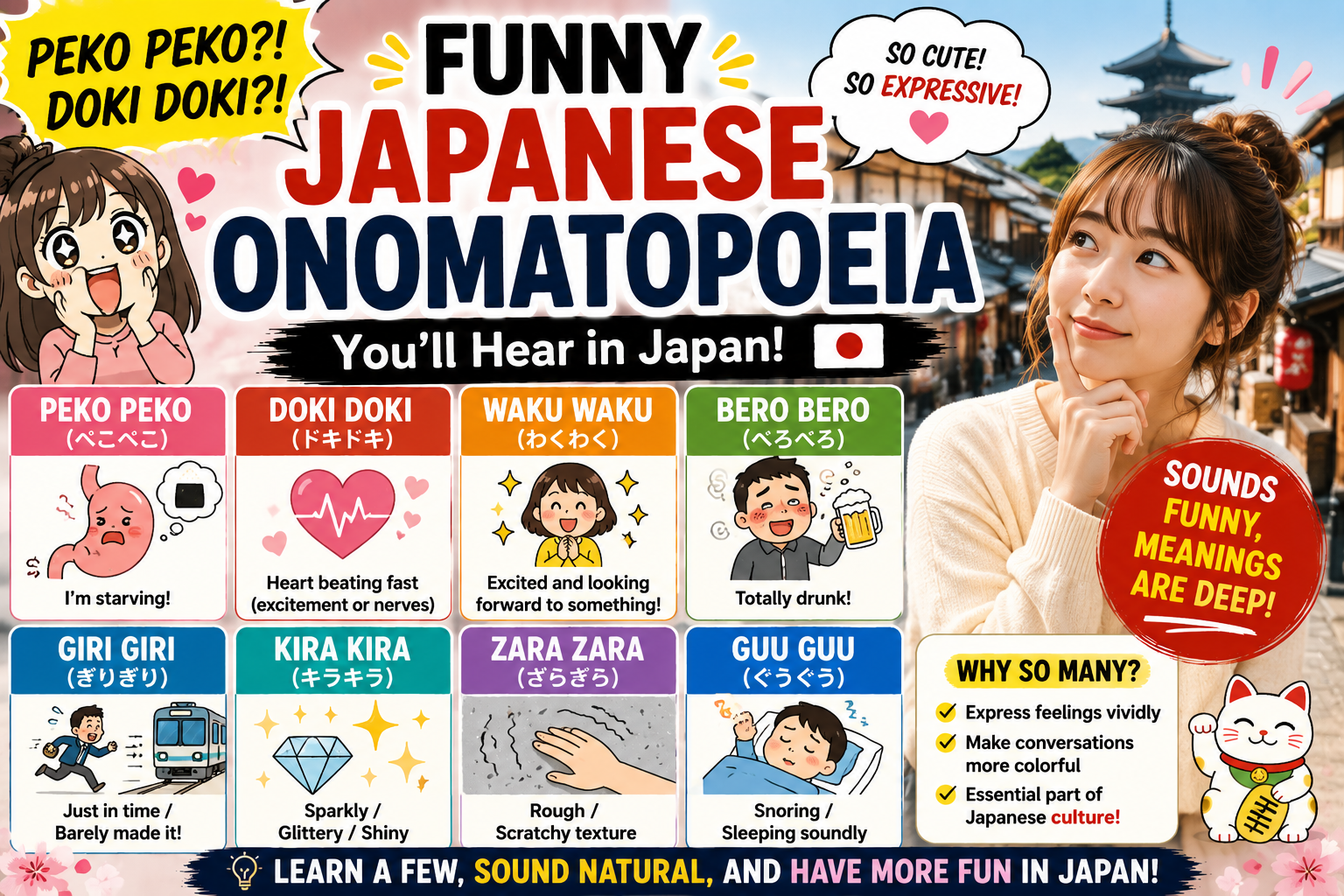
Peko Peko (ぺこぺこ): “I’m Starving!”
Peko peko describes the feeling of being extremely hungry.
The image is that your stomach is making noises because you’re so hungry.
You might hear someone say:
“Onaka peko peko!”
which means:
“I’m starving!”
or
“My stomach is growling!”
Fun fact: Japan’s famous Fujiya candy mascot is named Peko-chan.
Doki Doki (ドキドキ): Heart Beating Fast
Doki doki describes the sound and feeling of your heart pounding.
It can be used when you’re:
- Nervous
- Excited
- In love
- Scared
- Anticipating something
Examples:
- Before a first date
- During an exam
- Watching a horror movie
- Meeting your favorite celebrity
Anime fans hear this expression all the time.
Waku Waku (わくわく): Excited Anticipation
Waku waku describes the happy excitement you feel when looking forward to something.
For example:
- Going on vacation
- Opening a present
- Visiting Japan for the first time
- Seeing your favorite band
A common expression is:
“Waku waku suru!”
which means:
“I’m so excited!”
This is one of the most cheerful words in Japanese.
Bero Bero (べろべろ): Completely Drunk
If someone says a person is bero bero, it means they are extremely drunk.
For example:
“Kinō wa bero bero ni natta.”
“I got completely drunk yesterday.”
Because the word sounds silly, it often adds a humorous feeling to the conversation.
Giri Giri (ぎりぎり): Just Barely
Giri giri means:
- Just in time
- Barely
- At the last possible moment
Examples include:
- Catching a train before the doors close
- Submitting homework seconds before the deadline
- Arriving at the airport just in time
For example:
“Giri giri maniatta!”
“I barely made it!”
Many people use this expression almost every day.
Kira Kira (キラキラ): Sparkling and Shiny
Kira kira describes things that sparkle or shine.
Examples include:
- Stars
- Diamonds
- Glitter
- Jewelry
- Magical effects in anime
Children often use the word to describe things they find beautiful.
Interestingly, Japanese also uses the expression:
“Kira kira names”
to describe unusual or extravagant baby names.
Zara Zara (ざらざら): Rough and Scratchy
Zara zara describes rough textures.
Examples include:
- Sandpaper
- Dry skin
- Rough walls
- Certain fabrics
Japanese uses many different onomatopoeia to describe textures, often with surprising precision.
Guu Guu (ぐうぐう): Sleeping or Snoring
Guu guu represents the sound of sleeping or snoring.
It’s similar to saying:
“Zzz…”
in English.
You might hear:
“Kare wa guu guu neteita.”
“He was sleeping soundly.”
This expression appears frequently in manga and anime.
Why Does Japanese Have So Many Onomatopoeia?
Japanese onomatopoeia developed because the language places great value on:
- Sensory descriptions
- Emotional expression
- Visual imagery
- Shared experiences
These expressions help conversations feel:
- More vivid
- More emotional
- More expressive
- More natural
In many situations, using onomatopoeia actually sounds more natural than using ordinary descriptive words.
Should Japanese Learners Use Onomatopoeia?
Absolutely.
Learning a few common onomatopoeia can help you:
- Understand anime and manga
- Sound more natural
- Improve listening skills
- Better understand Japanese culture
Even learning just a few expressions like:
- Doki doki
- Waku waku
- Peko peko
- Giri giri
can make your Japanese sound much more authentic.
FAQ
What is Japanese onomatopoeia?
Japanese onomatopoeia are expressive words that describe sounds, emotions, actions, appearances, and physical sensations.
Why does Japanese have so many onomatopoeia?
Japanese culture values vivid expression and sensory descriptions, which led to the development of thousands of onomatopoeic expressions.
What is the most common Japanese onomatopoeia?
Some of the most common include:
- Doki doki
- Waku waku
- Peko peko
- Giri giri
- Kira kira
Do Japanese people use onomatopoeia every day?
Yes. Onomatopoeia is extremely common in everyday conversation.
Should foreigners learn Japanese onomatopoeia?
Yes. Learning even a few expressions can make your Japanese sound more natural and help you understand native speakers.