Welcome to the world of Japanese slang.
Japanese slang changes quickly and reflects:
- Internet culture
- Social media trends
- Youth culture
- Humor
- Pop culture
Learning slang isn’t necessary for speaking Japanese, but understanding it can give you a fascinating look into how young people in Japan actually communicate.
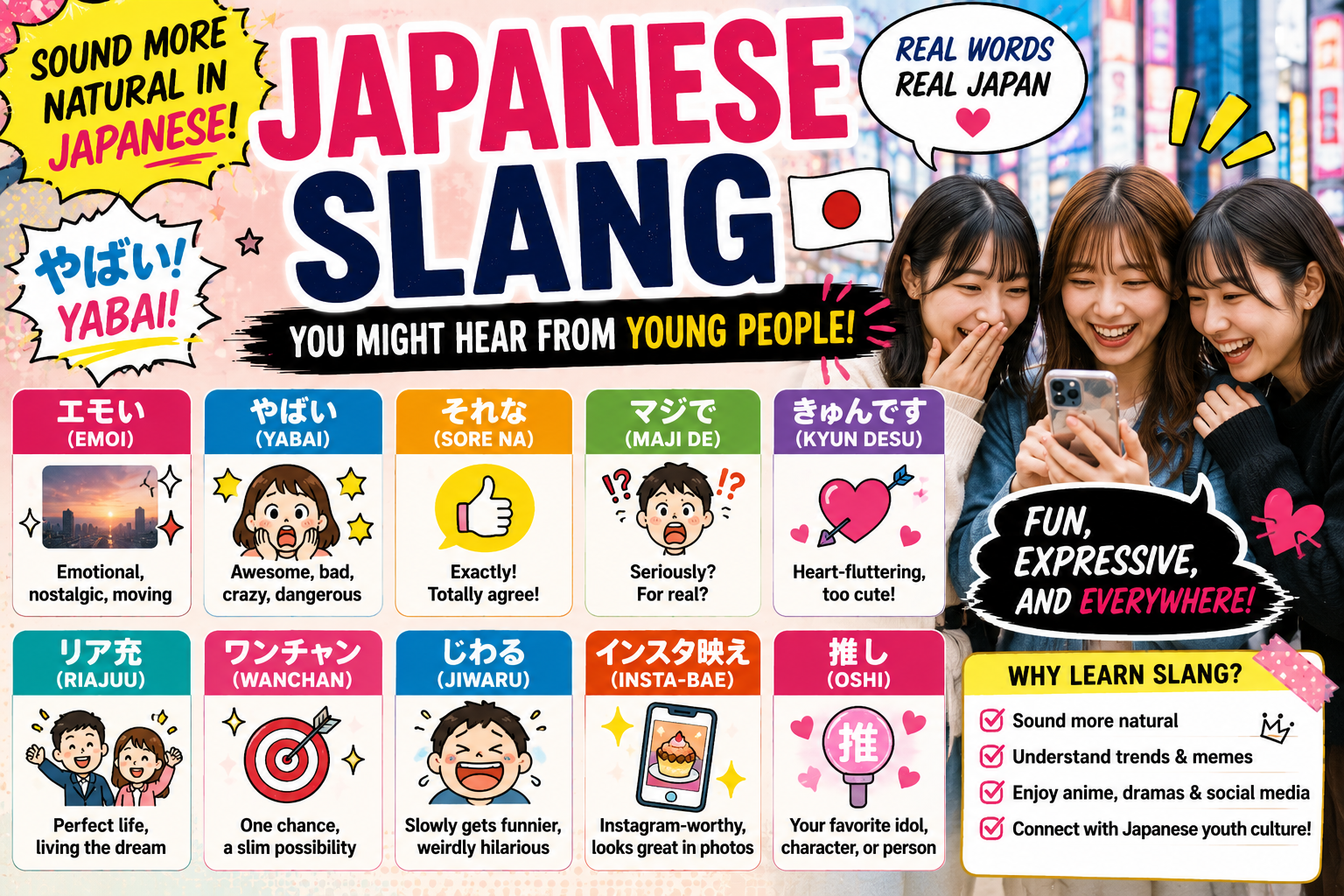
Here are some popular Japanese slang expressions you may hear in conversations, on social media, or in Japanese TV shows and anime.
Emoi (エモい)
Originally derived from the English word “emotional,” emoi describes something that feels:
- Emotional
- Nostalgic
- Moving
- Sentimental
It can refer to:
- Movies
- Music
- Photographs
- Memories
- Beautiful moments
Example:
「あの映画、めっちゃエモかった。」
Ano eiga, meccha emo katta.
“That movie was incredibly emotional.”
Yabai (やばい)
Yabai may be the most versatile slang word in modern Japanese.
Originally, it meant:
- Dangerous
- Bad
- Trouble
Today, however, young people use it to mean almost anything.
It can express:
- Amazing
- Awesome
- Terrible
- Crazy
- Incredible
- Dangerous
Examples:
「このケーキ、やばいほど美味しい!」
“This cake is insanely delicious!”
「テスト全然できなかった…やばい。」
“I totally failed the test. This is bad.”
Context is everything.
Sore Na (それな)
Sore na is a casual way of saying:
- Exactly!
- Totally!
- I agree!
It’s especially common:
- Among friends
- In group chats
- On social media
- In online comments
Example:
「宿題多すぎるよね。」
“There’s way too much homework.”
「それな!」
“Exactly!”
Maji De (マジで)
Maji de means:
- Seriously?
- For real?
- Seriously!
It can express surprise or emphasize a statement.
Examples:
「マジで?知らなかった!」
“Seriously? I didn’t know that!”
「マジで疲れた。」
“I’m seriously tired.”
This expression is extremely common among younger people.
Kyun Desu (きゅんです)
Kyun imitates the feeling of your heart tightening when you experience something:
- Cute
- Romantic
- Adorable
- Heartwarming
The phrase became especially popular through TikTok and social media.
Example:
「彼の笑顔にきゅんです!」
“His smile gave me butterflies!”
Riajuu (リア充)
Riajuu comes from:
リアルが充実している
(Real life is fulfilling)
It describes someone who appears to have a successful or happy life, including:
- Relationships
- Friends
- Hobbies
- Social activities
Example:
「彼女できたの?リア充じゃん!」
“You got a girlfriend? You’re living the dream!”
The word is often used humorously.
Wanchan (ワンチャン)
Short for:
“One chance.”
Wanchan refers to:
- A small possibility
- A lucky chance
- Taking a shot
Example:
「ワンチャン告白してみる。」
“I might confess my feelings. There’s a chance.”
Young people often use this expression playfully.
Jiwaru (じわる)
Jiwaru comes from:
Jiwa jiwa
meaning something that gradually develops.
It usually refers to humor that becomes funnier the more you think about it.
Example:
「あの画像、じわる。」
“That image is weirdly funny.”
This expression is especially common online.
Insta-Bae (インスタ映え)
A combination of:
- 映える (haeru, meaning “to look good”)
Insta-bae refers to something that is:
- Photogenic
- Stylish
- Perfect for social media
Example:
「このカフェ、めっちゃインスタ映えするね。」
“This café is totally Instagram-worthy.”
The phrase became one of Japan’s biggest social media buzzwords.
Oshi (推し)
Oshi refers to:
- Your favorite idol
- Favorite singer
- Favorite anime character
- Favorite celebrity
- Favorite public figure
The word comes from the verb:
推す (osu)
meaning “to support.”
Example:
「私の推しはBTSのジミンです!」
“My favorite is Jimin from BTS!”
Today, many Japanese people proudly talk about their oshi.
Why Does Learning Slang Matter?
Slang offers insight into how people actually communicate.
Understanding slang helps you:
- Sound more natural
- Understand social media
- Follow memes
- Enjoy anime and dramas
- Better understand youth culture
You don’t necessarily need to use these expressions yourself.
Simply recognizing them can greatly improve your understanding of modern Japanese.
Should Foreigners Use Japanese Slang?
Yes—but carefully.
Some slang expressions change quickly, and using too much slang can sound unnatural.
A good approach is:
- Listen first
- Understand the context
- Use simple expressions naturally
Even knowing a few words like:
- Yabai
- Maji de
- Sore na
- Oshi
can help you understand everyday conversations much better.
FAQ
What is Japanese slang?
Japanese slang refers to informal expressions commonly used by younger generations and on social media.
What is the most common Japanese slang word?
Many people consider yabai to be one of the most common and versatile Japanese slang words.
What does “oshi” mean?
Oshi refers to your favorite celebrity, idol, anime character, or person that you support.
Is Japanese slang used in anime?
Yes. Many anime, dramas, and online videos use modern Japanese slang.
Should Japanese learners study slang?
Yes. Understanding slang can help you understand modern Japanese culture and everyday conversations.