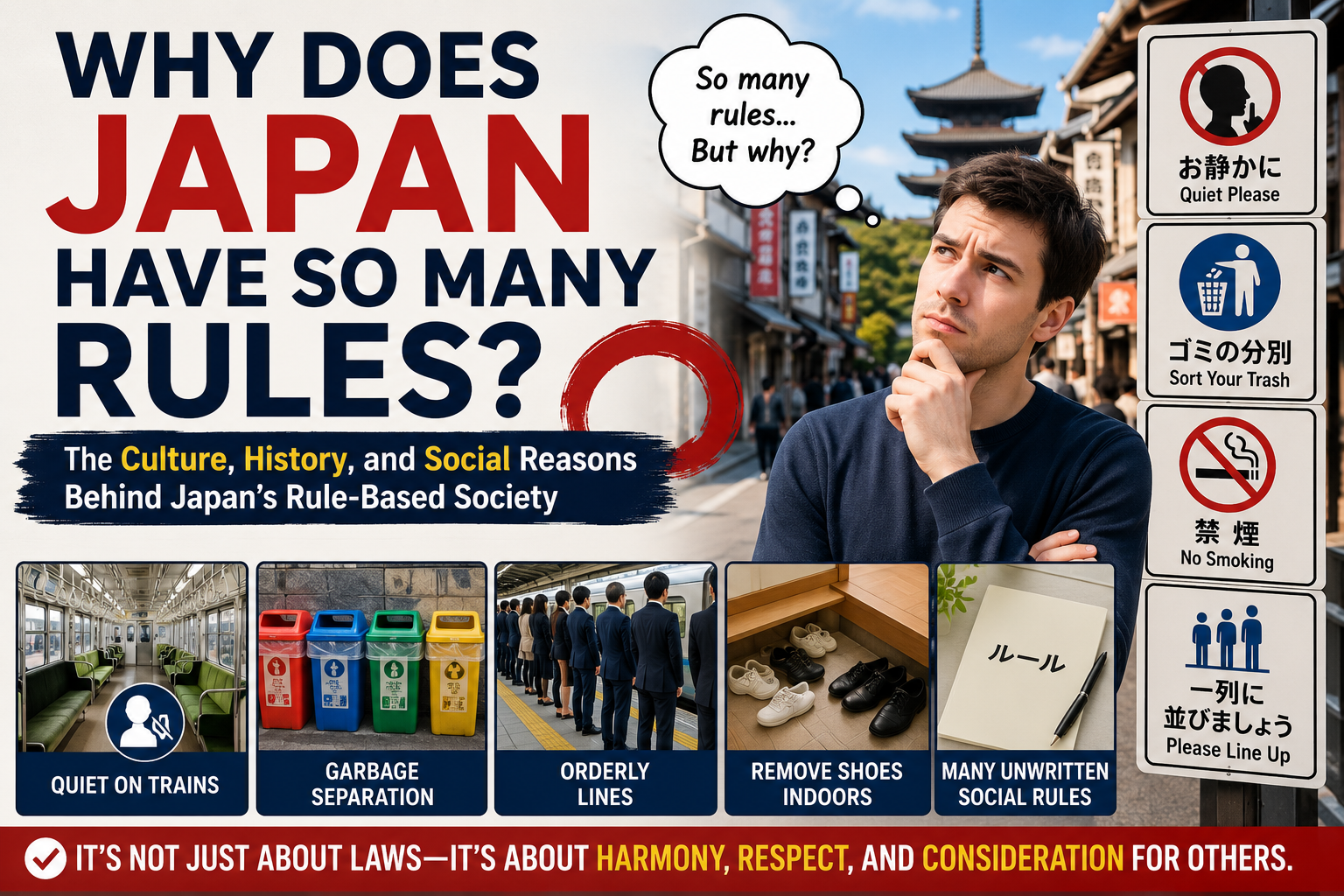
If you’ve ever visited Japan, you’ve probably noticed something quickly: Japan seems to have a lot of rules.
Examples include:
- Standing on a particular side of the escalator
- Separating garbage into multiple categories
- Staying quiet on trains
- Removing shoes indoors
- Waiting perfectly in line
- Following detailed workplace etiquette
- Observing countless social customs
For many foreigners, Japan can feel like one of the most rule-oriented societies in the world.
This naturally raises the question:
“Why does Japan have so many rules?”
The answer goes far beyond laws and regulations. Japan’s rule-based culture developed through centuries of history, social values, and practical necessities that continue to shape daily life today.
In this article, we’ll explore why rules play such an important role in Japanese society and why many Japanese people willingly follow them.
Japanese Society Values Harmony Over Individual Freedom
Perhaps the biggest reason Japan has so many rules is the cultural importance of social harmony, known as wa (和).
In many Western societies, individual freedom is often prioritized.
In Japan, however, people are generally encouraged to consider:
- How their actions affect others
- Maintaining group harmony
- Avoiding conflict
- Preventing inconvenience
The goal isn’t necessarily to restrict personal freedom, but to create a society where millions of people can live together smoothly.
This mindset influences almost every aspect of daily life.
Japan Is One of the Most Densely Populated Countries
Japan’s population density has also shaped its culture of rules.
In large cities like Tokyo and Osaka, millions of people share:
- Trains
- Sidewalks
- Apartment buildings
- Schools
- Offices
- Public spaces
When so many people live close together, even small inconveniences can affect thousands of others.
Rules help ensure that crowded environments remain:
- Efficient
- Predictable
- Clean
- Safe
Without strong social norms, daily life in Japan’s major cities would become much more chaotic.
Many Japanese Rules Are Actually Social Expectations
One thing that surprises foreigners is that many Japanese “rules” are not laws at all.
Examples include:
- Not talking loudly on trains
- Avoiding phone calls on public transportation
- Not eating while walking
- Standing in orderly lines
- Giving gifts in certain situations
These behaviors are often unwritten social expectations rather than legal requirements.
Breaking them usually won’t result in punishment, but it may cause social discomfort or disapproval.
This social pressure is often more effective than formal enforcement.
Japan’s Education System Emphasizes Discipline
Japanese children begin learning social responsibility at a very young age.
Schools teach students to:
- Follow schedules
- Respect authority
- Work together
- Clean classrooms
- Participate in group activities
- Consider the needs of others
Unlike some countries, Japanese schools often place as much emphasis on behavior and cooperation as they do on academic achievement.
These experiences help create adults who are comfortable following social rules and expectations.
Historical Influences Shaped Japan’s Rule-Based Culture
Japan’s history has also contributed to its strong rule-oriented society.
For centuries, Japanese society was organized around:
- Strict social hierarchies
- Group loyalty
- Community obligations
- Respect for authority
Influences from:
- Confucian philosophy
- Samurai culture
- Village communities
- Family structures
helped establish social systems that emphasized order, responsibility, and cooperation.
Many of these values remain visible in modern Japanese society.
Rules Help Create Japan’s Famous Safety and Cleanliness
Many foreigners admire Japan for its:
- Low crime rate
- Clean streets
- Efficient transportation
- Polite behavior
- Public safety
These achievements are closely connected to Japan’s culture of rules and social expectations.
For example:
- People sort their garbage carefully.
- Passengers queue patiently.
- Drivers follow traffic rules strictly.
- Citizens respect public property.
The result is a society that often feels highly organized and predictable.
Japanese Companies Also Have Many Rules
Japanese workplaces are famous for having detailed rules and procedures.
Examples include:
- Formal greetings
- Dress codes
- Hierarchical communication
- Business card etiquette
- Meeting protocols
- Work schedules
These systems are designed to:
- Avoid misunderstandings
- Maintain professionalism
- Promote teamwork
- Create predictable working environments
While younger generations sometimes criticize excessive workplace rules, many companies still maintain traditional practices.
Are There Too Many Rules in Japan?
Not all Japanese people enjoy living in a highly regulated society.
Some criticisms include:
- Excessive bureaucracy
- Resistance to change
- Social pressure
- Workplace rigidity
- Fear of making mistakes
In recent years, many younger Japanese have questioned whether certain rules remain necessary.
In fact, the Japanese term “kuso rules” (クソルール) has become popular for describing rules that people consider pointless or outdated.
As Japanese society changes, discussions about reducing unnecessary rules have become increasingly common.
Why Foreigners Sometimes Experience Culture Shock
Foreign visitors often experience culture shock because Japanese rules may seem unusually detailed.
Common surprises include:
- Multiple categories of garbage separation
- Strict train etiquette
- Complex gift-giving customs
- Numerous workplace expectations
- Social pressure to avoid inconveniencing others
However, many visitors also discover that these rules contribute to the things they love most about Japan:
- Safety
- Cleanliness
- Efficiency
- Courtesy
- Social order
Final Thoughts
Japan has so many rules because its society places a strong emphasis on:
- Social harmony
- Group cooperation
- Respect for others
- Predictability
- Public order
Many Japanese rules are not enforced by law but by shared cultural expectations that have developed over centuries.
While some people view these rules as restrictive, others believe they help create the safe, organized, and polite society that Japan is famous for around the world.
Understanding Japan’s rule-based culture provides valuable insight into how Japanese society functions—and why it often feels so different from many Western countries.
FAQ
Why do Japanese people follow so many rules?
Japanese culture strongly values social harmony, respect for others, and avoiding inconvenience to the community.
Are all Japanese rules actual laws?
No. Many Japanese rules are social customs and expectations rather than legally enforced regulations.
Why is Japan so strict about public behavior?
Because Japan’s densely populated society depends heavily on cooperation and predictable behavior.
Do Japanese people ever complain about rules?
Yes. Many people criticize unnecessary or outdated rules, especially younger generations.
Do rules make Japan safer?
Many experts believe Japan’s strong social norms contribute to its low crime rate, cleanliness, and public order.