Japan is often known for its safety, low crime rate, and orderly society. However, in recent years, a disturbing phenomenon called “Yami Baito” (闇バイト) has become one of the country’s most serious social concerns.
The term literally means “dark part-time job,” but these are not ordinary part-time jobs.
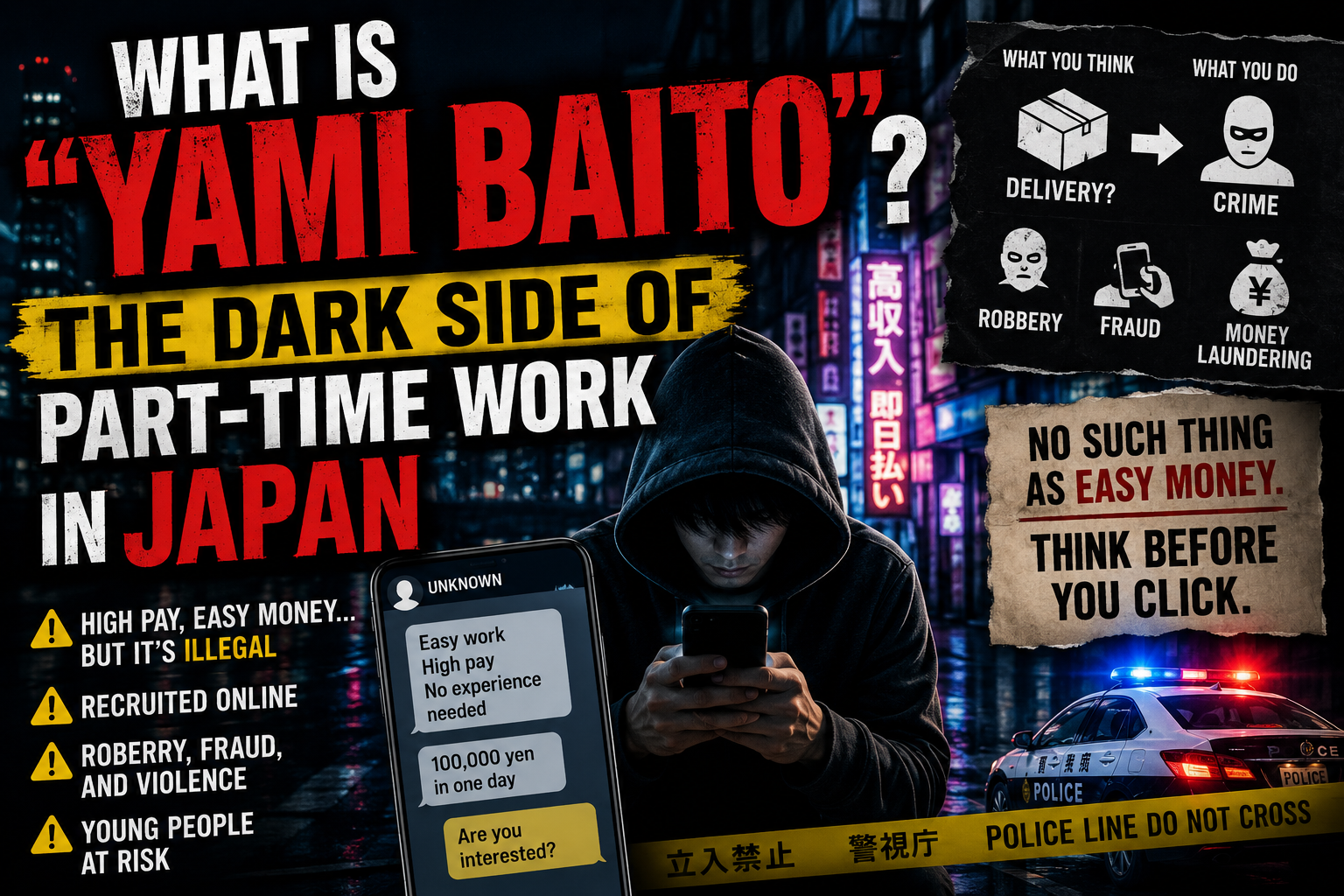
Instead, Yami Baito refers to criminal activities disguised as high-paying temporary work opportunities. Thousands of young people have been recruited through social media and online messaging apps, often without fully understanding the danger until it is too late.
This has shocked many Japanese people and raised important questions about crime, social pressure, and economic insecurity in modern Japan.
In this article, we’ll explain what Yami Baito is, how it works, why it has become so common, and what it reveals about Japanese society today.
What Does “Yami Baito” Mean?
In Japanese:
- Yami (闇) means “dark,” “underground,” or “illegal.”
- Baito (バイト) comes from the German word Arbeit and means “part-time job.”
Together, Yami Baito refers to illegal or criminal jobs advertised as easy ways to earn money.
Typical advertisements promise:
- “Earn ¥100,000 in one day”
- “No experience necessary”
- “Cash paid immediately”
- “Simple delivery work”
- “High income guaranteed”
However, the actual “job” often involves criminal activity.
What Crimes Are Involved?
People recruited through Yami Baito networks may be instructed to participate in crimes such as:
- Fraud scams targeting elderly people
- Robbery
- Burglary
- Money laundering
- Drug transportation
- Cash collection schemes
- Identity fraud
- Receiving stolen property
In recent years, several violent robbery cases in Japan have been linked to organized Yami Baito groups.
Many participants claim they initially believed they were accepting legitimate work opportunities.
How Do Criminal Groups Recruit People?
Unlike traditional organized crime, Yami Baito recruiters often operate online.
Common recruitment platforms include:
- Social media platforms
- Messaging apps
- Anonymous online forums
- Part-time job advertisements
- Private chat groups
Recruiters frequently target:
- Students
- Young adults
- People with debt
- Financially struggling workers
- Socially isolated individuals
The advertisements intentionally avoid mentioning illegal activity until after contact has been established.
Why Do Young People Fall for Yami Baito?
Many foreigners are surprised that young people in Japan become involved in these schemes.
However, experts point to several factors:
Financial Pressure
Some participants face:
- Student debt
- Gambling problems
- Consumer debt
- Low wages
- Economic insecurity
The promise of quick money can become extremely attractive.
Social Isolation
Japan has faced increasing problems with:
- Loneliness
- Social withdrawal
- Mental health struggles
- Lack of support networks
Criminal organizations often exploit vulnerable individuals.
Underestimating the Risk
Some recruits believe they are performing minor tasks, such as:
- Delivering packages
- Picking up cash
- Renting bank accounts
Only later do they realize they have become involved in organized crime.
Criminal Organizations Use Fear and Intimidation
One of the most disturbing aspects of Yami Baito is what happens after recruitment.
Recruiters often demand personal information such as:
- Government identification
- Home addresses
- Family information
- Phone numbers
- Bank account details
If participants attempt to quit, criminal groups may threaten:
- Violence
- Exposure to family members
- Harassment
- Retaliation
As a result, some people feel trapped after accepting the job.
Why Has Yami Baito Become a Major Issue in Japan?
Several factors have contributed to the rise of Yami Baito:
- Increased use of social media
- Economic uncertainty
- Rising living costs
- Greater social isolation
- Sophisticated criminal networks
- Anonymous communication technology
Japanese police have repeatedly warned that anyone can become a target for recruitment.
The problem has become serious enough that major public awareness campaigns now regularly appear on television, social media, and public transportation.
Is Yami Baito Connected to the Yakuza?
Sometimes, but not always.
Traditional organized crime groups, known as the Yakuza, have historically recruited members directly.
Modern Yami Baito operations often function differently:
- They use decentralized networks.
- Recruiters may never meet participants.
- Communication occurs almost entirely online.
- Multiple criminal groups may cooperate.
Some experts believe Yami Baito represents a new form of organized crime adapted for the digital age.
Why Are Foreigners Interested in This Story?
Many foreigners are surprised because Yami Baito seems inconsistent with Japan’s reputation as one of the world’s safest countries.
However, the existence of Yami Baito demonstrates an important reality:
Even very safe societies face serious social problems.
In fact, Yami Baito reveals several hidden challenges in modern Japan, including:
- Youth poverty
- Social isolation
- Mental health issues
- Economic insecurity
- Online criminal activity
- Demographic change
Understanding Yami Baito provides a deeper and more realistic view of Japanese society.
What Is the Japanese Government Doing?
Japanese authorities have increased efforts to combat Yami Baito by:
- Monitoring online recruitment
- Arresting recruiters
- Increasing public awareness campaigns
- Encouraging reporting of suspicious advertisements
- Strengthening cybercrime investigations
Police regularly warn:
“There is no such thing as easy money.”
The government has also emphasized education programs aimed at preventing young people from becoming victims.
Final Thoughts
Yami Baito is one of the most disturbing social phenomena in modern Japan.
What begins as a promise of quick money can quickly become involvement in:
- Fraud
- Robbery
- Organized crime
- Violence
- Extortion
The rise of Yami Baito reflects broader problems facing Japanese society, including economic pressure, loneliness, and the growing influence of online criminal networks.
While Japan remains one of the safest countries in the world, the Yami Baito phenomenon serves as a reminder that every society has hidden challenges beneath the surface.
Understanding these problems helps us see a more complete picture of contemporary Japan.
FAQ
What does Yami Baito mean?
Yami Baito (闇バイト) literally means “dark part-time job” and refers to illegal jobs disguised as high-paying work opportunities.
Is Yami Baito related to the Yakuza?
Sometimes, but many Yami Baito operations are run through decentralized online criminal networks.
Who becomes involved in Yami Baito?
Victims often include students, young adults, people with debt, and financially vulnerable individuals.
How do recruiters find victims?
Most recruitment now occurs through social media, messaging apps, and online advertisements.
Is Yami Baito a serious problem in Japan?
Yes. Japanese authorities consider Yami Baito one of the country’s major emerging crime problems.