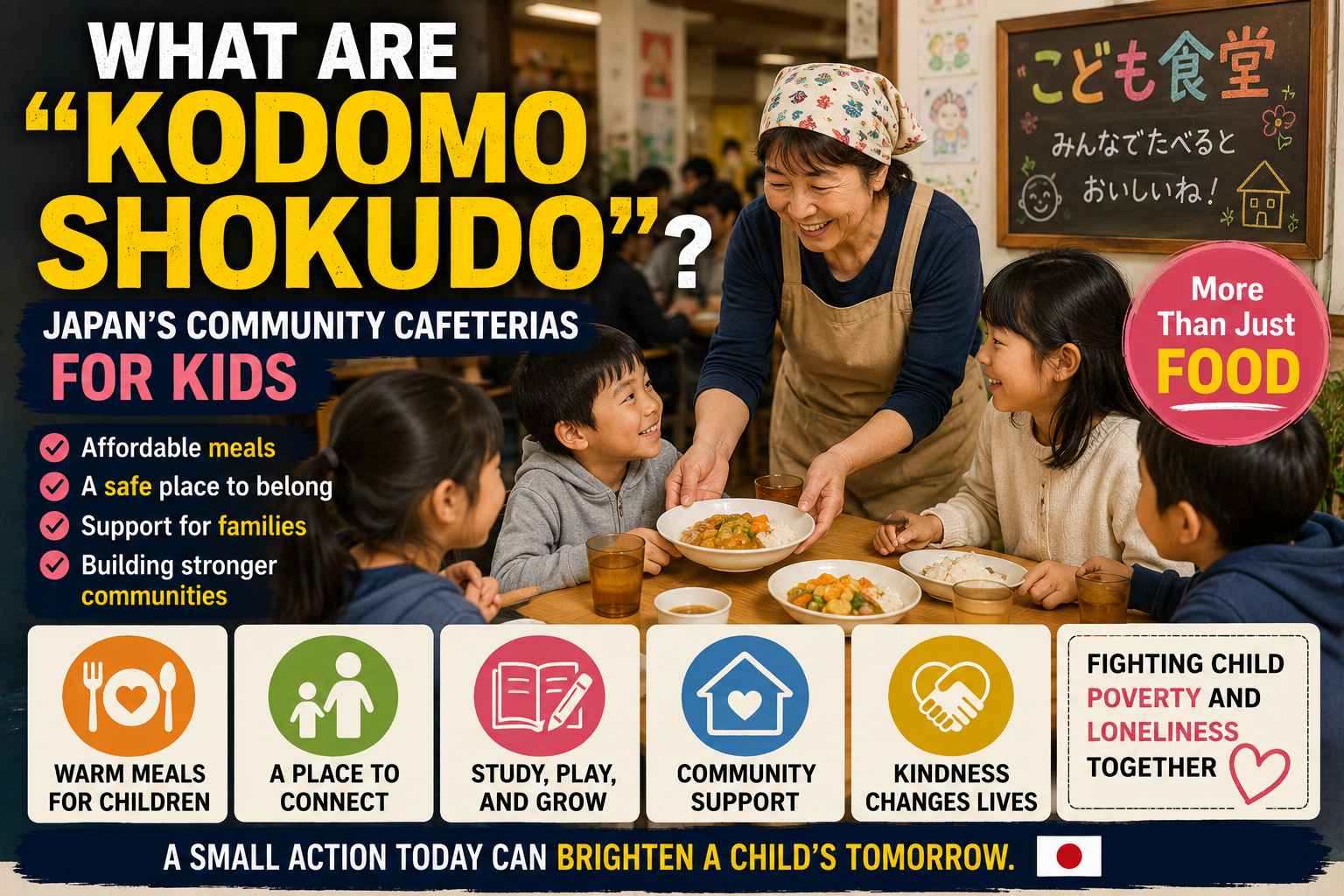
Japan is often seen as a wealthy, safe, and highly organized country. But behind that image, many children and families face hidden struggles such as poverty, loneliness, and food insecurity. One grassroots movement trying to solve this problem is called Kodomo Shokudo.
The term means “children’s cafeteria” in Japanese.
These community cafeterias provide free or low-cost meals to children, families, and sometimes elderly residents. But they are not just about food.
They are also about creating a place where children feel safe, welcomed, and connected.
What Does “Kodomo Shokudo” Mean?
In Japanese:
- Kodomo means “child” or “children.”
- Shokudo means “cafeteria” or “dining hall.”
So, Kodomo Shokudo literally means “children’s cafeteria.”
However, the meaning is broader than a simple place to eat.
A Kodomo Shokudo is usually a local community space where children can:
- Eat affordable meals
- Meet trusted adults
- Spend time after school
- Study or do homework
- Feel less alone
- Build connections with neighbors
Some cafeterias are mainly for children in need, while others welcome anyone in the community.
Why Do Kodomo Shokudo Exist?
Many foreigners are surprised to hear about child poverty in Japan.
Japan is not usually associated with hunger or poverty, but some families struggle with:
- Low income
- Single-parent households
- Long working hours
- Rising food prices
- Social isolation
- Lack of family support
Some children eat alone because their parents work late. Others may not have enough nutritious meals at home.
Kodomo Shokudo were created to give these children a warm meal and a place where they are not alone.
They Are Not Only for Poor Children
One important point is that Kodomo Shokudo are usually not designed to publicly label children as “poor.”
That would create stigma and discourage families from coming.
Instead, many cafeterias are open to all children and local residents.
This helps create a more natural atmosphere where children from different backgrounds can eat together without embarrassment.
In many places, adults and elderly people also join.
This makes Kodomo Shokudo more like a community dining space than a charity service.
How Much Does It Cost?
Prices vary depending on the location.
Many Kodomo Shokudo offer meals for:
- Free
- Around ¥100 to ¥300 for children
- A slightly higher price for adults
Some places use donations, food banks, volunteers, and local government support to keep meals affordable.
The goal is not profit.
The goal is to make sure children can eat safely and comfortably.
Who Runs Kodomo Shokudo?
Most Kodomo Shokudo are run by local volunteers, nonprofit groups, restaurants, religious organizations, community centers, or neighborhood associations.
The people involved may include:
- Retired residents
- Parents
- Teachers
- Social workers
- Local restaurant owners
- Students
- Company volunteers
This grassroots nature is one of the most important features of the movement.
Kodomo Shokudo are not just government programs. They are often built by ordinary people who want to support children in their own communities.
Why Are They Growing Across Japan?
Kodomo Shokudo have expanded rapidly across Japan in recent years.
According to reports, the number of children’s cafeterias in Japan has grown to more than 10,000 locations nationwide.
This growth reflects several social problems:
- Child poverty
- Rising living costs
- Loneliness among children
- Isolation of single parents
- Weakening neighborhood connections
- Aging communities
In other words, Kodomo Shokudo are not only about hunger.
They are also a response to the weakening of traditional community support.
Kodomo Shokudo Help Fight Loneliness
One of the most important roles of Kodomo Shokudo is preventing loneliness.
In Japan, some children eat dinner alone because their parents are working late.
This is sometimes called koshoku, meaning “eating alone.”
A child may have food at home but still lack emotional support, conversation, and a sense of belonging.
At a Kodomo Shokudo, children can share a meal with others, talk to adults, and feel part of a community.
That emotional support can be just as important as the meal itself.
They Also Support Parents
Kodomo Shokudo can also help parents, especially single mothers and low-income families.
For parents, these cafeterias may provide:
- Affordable meals
- Emotional support
- Local information
- Connections with other parents
- A safe place for children
- Access to social services
Some parents feel isolated and overwhelmed.
A Kodomo Shokudo can become a place where they feel seen and supported.
Challenges Facing Kodomo Shokudo
Despite their positive impact, Kodomo Shokudo face many challenges.
Common problems include:
- Lack of funding
- Shortage of volunteers
- Rising food costs
- Difficulty reaching families most in need
- Limited space
- Stigma around poverty
- Dependence on donations
Many operators want to help more children, but they do not always have enough money, food, or staff.
This makes long-term sustainability a major issue.
What Kodomo Shokudo Reveal About Japan
Kodomo Shokudo reveal a side of Japan that many tourists never see.
They show that Japan is not only a country of convenience stores, bullet trains, and clean streets.
It is also a country dealing with:
- Hidden poverty
- Social isolation
- Aging communities
- Family pressure
- Economic inequality
- Weakening local relationships
At the same time, Kodomo Shokudo also show Japan’s strength.
They represent kindness, community action, and the desire to protect children.
Final Thoughts
Kodomo Shokudo are one of the most meaningful grassroots movements in modern Japan.
They provide children with:
- Warm meals
- Safe spaces
- Human connection
- Community support
- A sense of belonging
While they cannot solve child poverty alone, they play an important role in supporting families and rebuilding local communities.
For foreigners who want to understand the real Japan, Kodomo Shokudo offer an important lesson:
Japan’s beauty is not only found in temples, anime, food, or technology.
It is also found in ordinary people quietly helping children who need support.
FAQ
What does Kodomo Shokudo mean?
Kodomo Shokudo means “children’s cafeteria” in Japanese. It refers to community spaces that provide free or low-cost meals to children and local residents.
Are Kodomo Shokudo only for poor children?
No. Many Kodomo Shokudo welcome all children and community members to avoid stigma.
Why are Kodomo Shokudo important?
They help address child poverty, loneliness, food insecurity, and social isolation in local communities.
Can adults use Kodomo Shokudo?
In many cases, yes. Some cafeterias welcome parents, elderly people, and other local residents.
Who runs Kodomo Shokudo?
They are usually run by volunteers, nonprofits, local residents, restaurants, community groups, and sometimes supported by local governments.