If you’re visiting Japan or watching Japanese movies and TV shows, one thing quickly becomes obvious: Japanese homes are surprisingly small.
Whether it’s a tiny Tokyo apartment, a narrow three-story house, or a compact family home, many foreigners wonder the same thing:
“Why are Japanese homes so small?”
The answer isn’t simply that Japan is a small country. In reality, several historical, economic, cultural, and practical factors have shaped the way Japanese people live today.
In this article, we’ll explore the real reasons why Japanese houses and apartments tend to be much smaller than those in countries like the United States, Canada, Australia, or Europe.
Japan Has Very Limited Livable Land
Many people know that Japan is geographically small, but that’s only part of the story.
Japan’s total land area is approximately 378,000 square kilometers, which isn’t extremely small compared to some European countries. The bigger issue is that around 70% of Japan is covered by mountains and forests, leaving relatively little flat land suitable for cities and housing.
As a result, millions of people are concentrated into relatively small urban areas such as:
- Tokyo
- Osaka
- Yokohama
- Nagoya
- Fukuoka
When land is scarce and demand is high, housing naturally becomes smaller.
For example, the Greater Tokyo metropolitan area has a population of over 37 million people, making it the world’s largest metropolitan area.
Land Prices in Japanese Cities Are Extremely High
Another major reason is the cost of land.
In major cities like Tokyo and Osaka, land prices can be extraordinarily expensive. Unlike some Western countries where suburban expansion is easier, Japanese cities have developed with limited space and high population density.
For many families, buying a large detached house in central Tokyo is simply unrealistic.
Instead, people often choose:
- Small condominiums
- Compact apartments
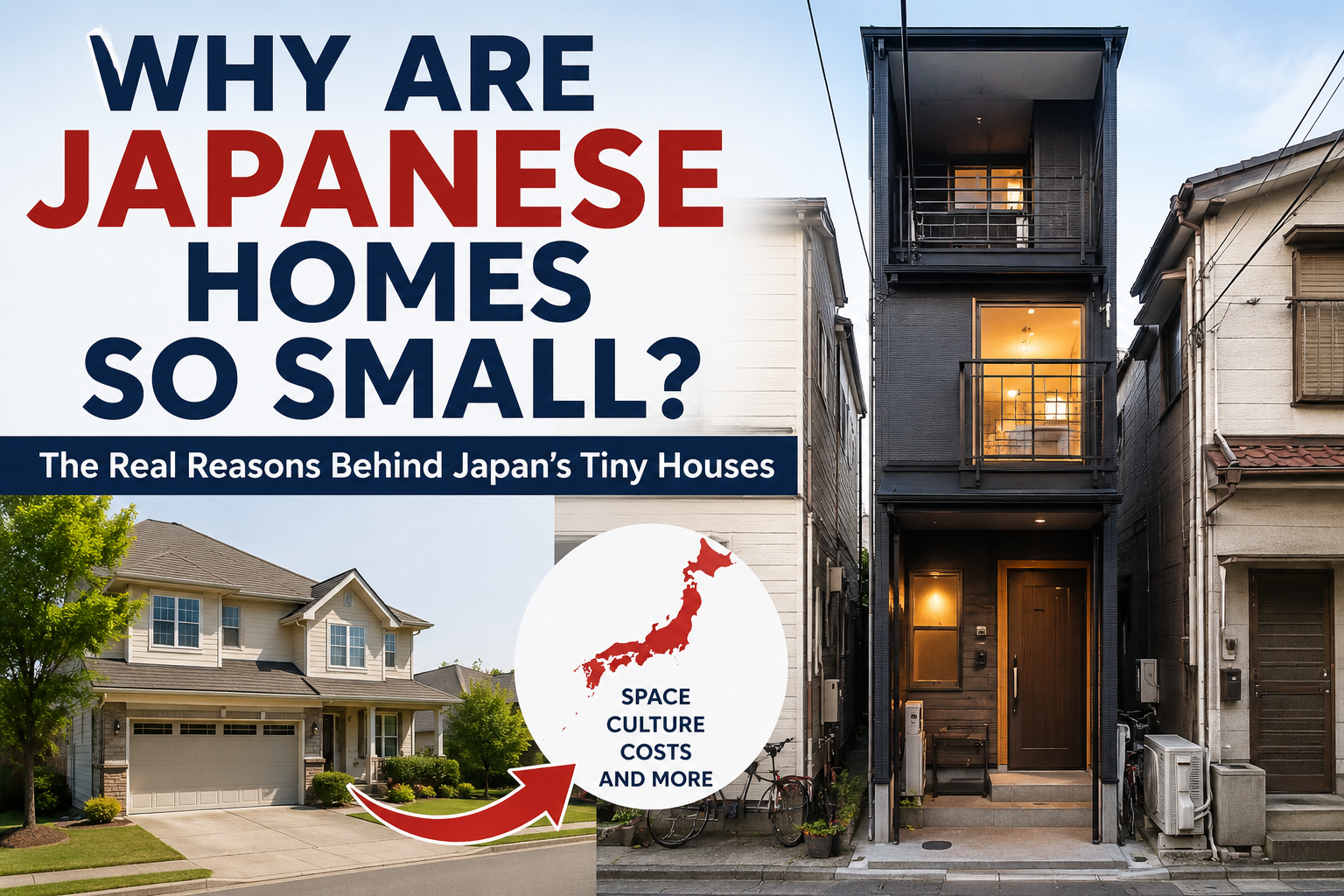
- Narrow multi-story homes
- Houses built on tiny plots of land
A typical urban family home in Japan may occupy only 80–120 square meters (860–1,290 square feet), including multiple floors.
Japanese Culture Values Efficient Use of Space
Japanese culture has long emphasized simplicity, minimalism, and efficient use of available space.
Traditional Japanese architecture developed several space-saving concepts that continue to influence modern homes today:
Multi-Purpose Rooms
Historically, rooms in Japanese houses were rarely assigned a single purpose.
For example:
- A room could function as a living room during the day.
- The same room could become a bedroom at night using futons.
- Dining spaces could serve multiple functions throughout the day.
This flexible approach reduced the need for larger houses.
Minimalism and Decluttering
The Japanese concept of simplicity is reflected in many aspects of daily life.
Many Japanese people prefer:
- Owning fewer possessions
- Organizing efficiently
- Maximizing small spaces
- Avoiding unnecessary clutter
This philosophy helps make smaller homes more practical and comfortable.
Japanese Homes Prioritize Location Over Size
In countries like the United States or Australia, people often prioritize having a larger house.
In Japan, however, many people prioritize:
- Living close to train stations
- Shorter commuting times
- Access to schools
- Convenience stores and supermarkets nearby
- Easy access to city centers
As a result, many Japanese families willingly accept smaller living spaces in exchange for a better location.
For example, a family may choose a 70-square-meter apartment located 20 minutes from central Tokyo rather than a larger house located two hours away.
Japanese Building Regulations Encourage Compact Housing
Japan’s strict zoning laws and building regulations also contribute to smaller homes.
Factors include:
- Building coverage ratios
- Floor-area ratio restrictions
- Narrow residential streets
- Earthquake-resistant construction requirements
Additionally, many urban plots of land are unusually shaped or very small, forcing architects to create highly efficient housing designs.
This has led to Japan becoming famous for its innovative compact architecture.
Earthquakes Have Influenced Japanese Housing Design
Japan experiences thousands of earthquakes every year.
Because of this, homes are designed with:
- Strong structural requirements
- Lightweight construction materials
- Frequent rebuilding cycles
Unlike in many Western countries where houses may last over 100 years, Japanese homes are often rebuilt after several decades.
This focus on practicality rather than permanence has also encouraged smaller, more affordable housing.
Japanese Homes Are Actually Becoming Larger Than Before
Surprisingly, Japanese homes today are larger than they were several decades ago.
According to government housing statistics, the average living space per person in Japan has gradually increased over time.
However, compared to countries such as:
- The United States
- Canada
- Australia
- Germany
Japanese homes remain relatively small because of urban density and land costs.
Are Japanese People Happy Living in Small Homes?
Many foreigners assume that Japanese people dislike living in small spaces.
In reality, opinions vary.
Some people enjoy:
- Lower housing costs
- Short commutes
- Convenient city living
- Less cleaning and maintenance
Others wish they had more space, especially families with children.
Ultimately, what feels “small” or “comfortable” depends heavily on cultural expectations and lifestyle preferences.
Final Thoughts
Japanese homes are small for many interconnected reasons:
- Limited buildable land
- High urban land prices
- Population density
- Cultural preferences for efficiency
- Prioritizing location over size
- Building regulations
- Earthquake considerations
While Japanese homes may seem tiny to visitors from larger countries, they reflect a unique balance between practicality, convenience, and cultural values.
Understanding why Japanese homes are small offers a fascinating insight into how Japanese society adapts to the realities of living in one of the world’s most densely populated countries.
FAQ
Why are apartments in Tokyo so small?
Tokyo has extremely high land prices and one of the highest population densities in the world, making smaller apartments more affordable and practical.
Are Japanese houses smaller than American houses?
Yes. The average Japanese home is significantly smaller than the average American home due to land costs, urban density, and cultural differences.
Do Japanese people prefer small homes?
Not necessarily. Many people would prefer larger homes, but they often prioritize location, convenience, and affordability.
Why do Japanese houses have multiple floors?
Because land plots are small, many homes are built vertically to maximize living space.
Are Japanese homes getting bigger?
Yes. Average living space in Japan has increased over recent decades, although homes remain smaller than those in many Western countries.