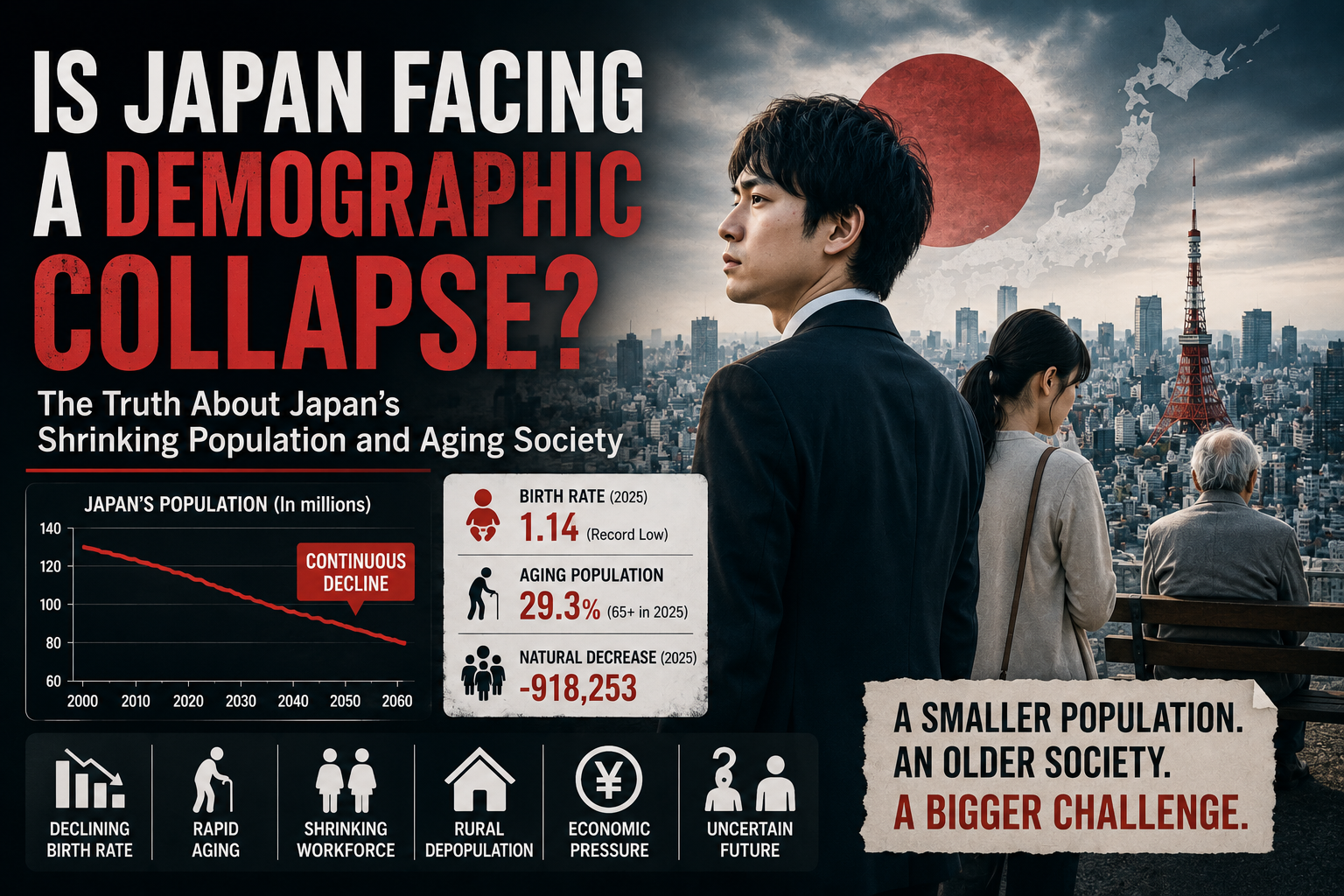
Is Japan facing a demographic collapse? This question has become increasingly common as Japan continues to experience record-low birth rates, rapid population aging, and a shrinking workforce.
The word “collapse” may sound dramatic, but Japan’s demographic situation is serious. The country is not disappearing overnight, but it is facing long-term population decline that could reshape its economy, communities, and social systems.
In this article, we’ll explore whether Japan is really facing a demographic collapse, what is causing the crisis, and what Japan’s future may look like.
What Does “Demographic Collapse” Mean?
A demographic collapse does not mean a country suddenly disappears.
It usually refers to a long-term decline in population caused by:
- Very low birth rates
- More deaths than births
- A shrinking working-age population
- Rapid aging
- Declining local communities
Japan shows many of these signs.
In 2025, Japan recorded only 671,236 births, while deaths remained far higher at 1,589,489. The country’s total fertility rate also fell to 1.14, another record low. This means Japan is experiencing a large natural population decline every year.
Japan’s Population Is Already Shrinking
Japan’s population peaked at around 128 million in the late 2000s. Since then, the country has been steadily losing people.
This decline is not temporary. Unless birth rates rise significantly or immigration increases dramatically, Japan’s population is expected to keep shrinking for decades.
A smaller population is not always a problem by itself. However, Japan’s challenge is that the population is shrinking while also aging rapidly.
Why Is Japan’s Birth Rate So Low?
One of the main reasons Japan may be facing a demographic collapse is its extremely low birth rate.
Raising Children Is Expensive
Many young couples worry about the cost of raising children. Expenses can include:
- Housing
- Childcare
- Education
- Private tutoring
- Daily living costs
- University preparation
In Japan, many parents feel strong pressure to invest heavily in their children’s education and future success.
Economic Insecurity Delays Family Formation
Many young adults face unstable employment, low wage growth, and uncertainty about their future income.
Because marriage and childbearing are often connected to financial stability in Japan, economic insecurity causes many people to delay or avoid starting a family.
Fewer Japanese People Are Getting Married
Marriage is closely connected to Japan’s birth rate.
In Japan, most children are still born within marriage. This means declining marriage rates directly affect the number of births.
Marriage Is Happening Later
Many Japanese people marry later than previous generations. Some wait until their 30s or beyond, while others never marry at all.
Delayed marriage often leads to fewer children, even among couples who eventually want a family.
Single Life Is More Accepted
Being single is becoming more normal in Japan, especially in large cities. Many people enjoy personal freedom, independent living, and career-focused lifestyles.
For some, marriage no longer feels necessary for happiness.
Japan’s Aging Society Is a Bigger Problem Than Population Decline Alone
Japan is not only losing people. It is becoming older.
More Elderly People, Fewer Workers
As the elderly population grows, Japan faces increasing pressure on:
- Healthcare
- Pensions
- Elder care
- Public finances
- Local services
At the same time, the number of working-age people is shrinking. This means fewer workers are supporting more retirees.
The 2025 Problem
Japan’s postwar baby boomer generation has now entered the 75-and-over age group. This creates additional pressure on healthcare, nursing care, and social welfare systems.
The issue is not just how many people Japan has, but the age balance of the population.
Rural Japan Is Already Feeling the Collapse
The demographic crisis is especially visible in rural areas.
Villages Are Losing Young People
Many young people leave rural communities for Tokyo, Osaka, Nagoya, or other major cities. As a result, rural towns often have:
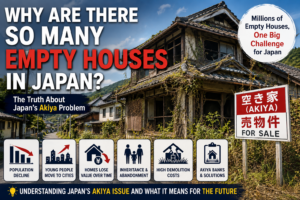
- Empty houses
- Closed schools
- Fewer local businesses
- Limited public transportation
- Shortages of doctors and caregivers
Some communities may eventually disappear or merge with neighboring towns.
Tokyo Is Not Immune
Even though Tokyo continues to attract people from across Japan, it is not completely safe from demographic decline.
A country cannot rely forever on moving young people from rural areas to big cities. Eventually, the national pool of young workers becomes smaller.
Labor Shortages Are Becoming More Serious
Japan’s shrinking workforce is already affecting many industries.
Industries Struggling to Find Workers
Labor shortages are especially serious in:
- Healthcare
- Elder care
- Construction
- Agriculture
- Logistics
- Hospitality
- Manufacturing
As the population ages, demand for care workers rises while the supply of young workers falls.
Automation May Help, But Not Solve Everything
Japan is investing in robots, AI, and automation to deal with labor shortages. These technologies can help in factories, logistics, and elder care.
However, automation cannot fully replace human workers in every industry, especially jobs requiring emotional support, communication, and hands-on care.
Could Immigration Prevent Demographic Collapse?
Immigration could help reduce labor shortages, but it is unlikely to fully reverse Japan’s demographic decline.
Japan has gradually accepted more foreign workers in recent years, especially in industries with severe labor shortages. However, immigration remains politically and socially sensitive.
For immigration to make a major difference, Japan would need not only more foreign workers, but also stronger support for long-term settlement, language learning, families, and integration.
Is Japan Really Collapsing?
Japan is not collapsing in the sense of sudden failure.
It remains one of the world’s largest economies, with advanced infrastructure, strong institutions, and high life expectancy.
However, Japan is facing a slow demographic transformation. The risks are real:
- A smaller workforce
- Higher tax burdens
- More pressure on pensions and healthcare
- Shrinking rural communities
- Lower domestic demand
- Greater difficulty supporting older citizens
So, the more accurate answer is:
Japan is not collapsing overnight, but it is facing a serious long-term demographic crisis.
What Can Japan Do?
There is no single solution.
Experts often argue that Japan needs a combination of policies, including:
- Higher wages
- Better job security
- Affordable housing
- Improved childcare
- Shorter working hours
- Greater gender equality
- More support for working parents
- Carefully managed immigration
- Better rural revitalization policies
Raising the birth rate alone would also take decades to affect the workforce, because children born today will not enter the labor market for many years.
What Does Japan’s Future Look Like?
Japan’s future will likely involve a smaller, older society.
This does not automatically mean disaster. A smaller population could reduce pressure on housing, energy, and the environment. Technology could also help Japan maintain productivity with fewer workers.
However, the transition will be difficult. Japan must redesign many parts of society for a future with fewer children, fewer workers, and more elderly citizens.
Conclusion
So, is Japan facing a demographic collapse?
Japan is not collapsing suddenly, but it is facing one of the most serious demographic challenges in the world. Record-low birth rates, declining marriages, rapid aging, rural depopulation, and labor shortages are all reshaping the country.
The real question is not whether Japan will disappear. It is whether Japan can adapt fast enough to build a sustainable society for a smaller and older population.
Frequently Asked Questions
Is Japan’s population really declining?
Yes. Japan’s population has been declining for years because deaths outnumber births.
What is Japan’s fertility rate?
Japan’s total fertility rate fell to 1.14 in 2025, far below the replacement level of 2.1.
Why is Japan aging so fast?
Japan is aging because people are living longer while fewer babies are being born.
Will Japan disappear in the future?
No. Japan will not disappear, but its population may become much smaller and older over time.
Can immigration solve Japan’s demographic crisis?
Immigration can help with labor shortages, but it is unlikely to solve the entire demographic crisis by itself.