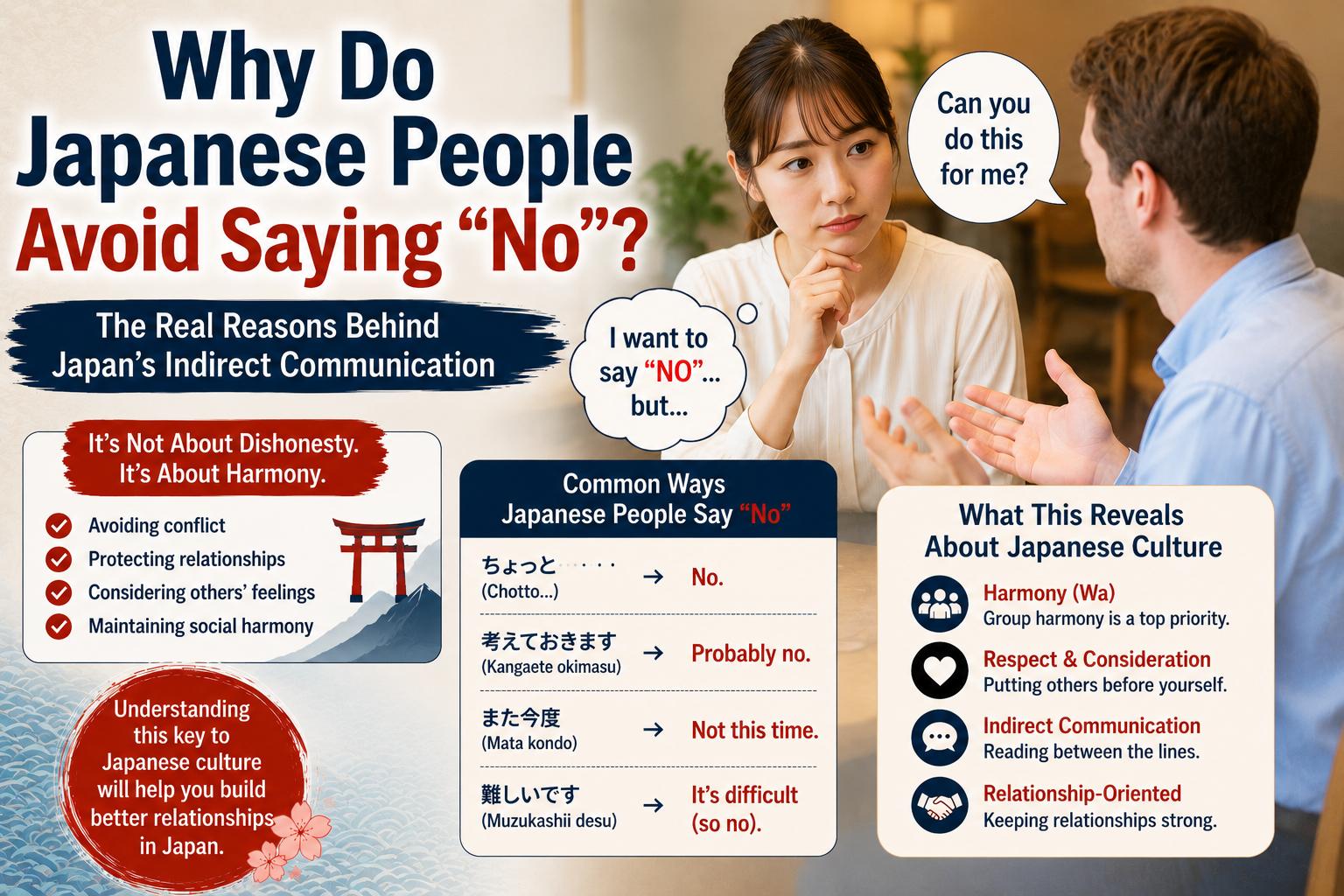
If you’ve spent time in Japan, you’ve probably experienced a confusing situation like this: You ask someone a question, and instead of saying “no”, they reply with:
- “That might be difficult.”
- “I’ll think about it.”
- “Maybe another time.”
- “It’s a little complicated.”
Many foreigners quickly discover that Japanese people often avoid saying “no” directly.
But why?
Is it because Japanese people are indecisive? Are they trying to be dishonest? Or is there a deeper cultural reason?
The answer lies in the values of harmony, respect, and indirect communication that have shaped Japanese society for centuries.
In this article, we’ll explain why Japanese people often avoid saying “no,” what they really mean, and how foreigners can better understand Japanese communication.
Do Japanese People Really Avoid Saying “No”?
Yes, generally speaking.
While Japanese people certainly do say “no” in some situations, direct refusal is often avoided in social, professional, and personal interactions.
Instead of saying:
“No.”
You might hear:
- “It’s a little difficult.”
- “I’ll have to think about it.”
- “Perhaps next time.”
- “That may be challenging.”
- “We’ll consider it.”
For many foreigners, these responses can be difficult to interpret.
The Most Important Reason: Maintaining Harmony (Wa)
The primary reason Japanese people avoid saying “no” is the cultural value of:
Wa (和) — social harmony.
Japanese society traditionally emphasizes:
- Maintaining peaceful relationships
- Avoiding confrontation
- Respecting others’ feelings
- Preserving group harmony
- Reducing social tension
A direct refusal can sometimes create:
- Embarrassment
- Conflict
- Hurt feelings
- Loss of face
Indirect communication helps minimize these risks.
Japanese Communication Is High-Context
Anthropologists often describe Japan as a:
High-context culture.
This means that communication relies heavily on:
- Context
- Tone of voice
- Facial expressions
- Relationship status
- Shared understanding
In many Western cultures, communication tends to be:
“Say exactly what you mean.”
In Japan, communication often works more like:
“Understand what is being implied.”
As a result, the literal words themselves may not tell the entire story.
Saying “No” Can Feel Rude
Many Japanese people grow up learning that directly rejecting someone may be considered impolite.
For example:
Instead of saying:
“I don’t want to go.”
Someone might say:
“I have plans.”
Instead of:
“I disagree.”
They may say:
“That’s one way of thinking.”
This approach allows both parties to maintain dignity and avoid unnecessary conflict.
The Influence of Tatemae and Honne
To understand indirect communication in Japan, it’s important to understand:
- Tatemae (建前) — public or socially acceptable behavior
- Honne (本音) — true feelings and opinions
A person’s public response may prioritize:
- Courtesy
- Social harmony
- Group relationships
rather than expressing their private feelings directly.
This doesn’t necessarily mean someone is being dishonest.
Instead, they may simply be trying to preserve a positive relationship.
Common Japanese Ways of Saying “No”
Foreigners living in Japan often learn to recognize certain phrases that actually mean “no.”
“Chotto…” (ちょっと…)
Literally:
“A little…”
Actual meaning:
“No.”
Example:
“Can you work this weekend?”
“Ah… chotto…”
This is often a polite refusal.
“Kangaete Oki Masu” (考えておきます)
Literal meaning:
“I’ll think about it.”
Possible meaning:
“Probably not.”
“Mata Kondo” (また今度)
Literal meaning:
“Another time.”
Possible meaning:
“I don’t intend to do this.”
“Muzukashii Desu” (難しいです)
Literal meaning:
“It’s difficult.”
Common interpretation:
“No.”
Understanding these phrases is an important part of understanding Japanese culture.
Why Is This Especially Confusing for Foreigners?
Many cultures value:
- Honesty
- Directness
- Efficiency
- Clear communication
As a result, foreigners may interpret Japanese responses literally.
For example:
Japanese person:
“Let’s get together sometime.”
Foreigner:
“Great! Let’s schedule it.”
Japanese person:
“…”
The Japanese speaker may have intended the phrase simply as a polite expression rather than a concrete invitation.
This difference in communication styles can create misunderstandings.
Japanese Business Culture and Saying “No”
Indirect communication is particularly common in Japanese business environments.
Employees often avoid:
- Open disagreement
- Direct criticism
- Rejecting proposals outright
- Public confrontation
Instead, discussions may involve:
- Hints
- Suggestions
- Indirect feedback
- Consensus-building
Foreign business professionals often describe learning to recognize indirect refusals as one of the biggest challenges of working in Japan.
Does Avoiding “No” Mean Japanese People Are Dishonest?
No.
This is one of the most common misconceptions about Japanese culture.
From a Japanese perspective, avoiding direct refusal may actually be considered:
- More respectful
- More considerate
- More mature
- More socially responsible
The goal is often to protect relationships rather than deceive others.
Are Younger Japanese People Becoming More Direct?
To some extent, yes.
Globalization, social media, and changing social values have encouraged younger generations to communicate more openly.
However, indirect communication remains deeply embedded in Japanese culture, especially in:
- Business
- Family relationships
- Formal settings
- Professional interactions
How Can Foreigners Better Understand Japanese Communication?
A few helpful tips include:
- Pay attention to context.
- Listen to tone of voice.
- Observe body language.
- Notice hesitation.
- Focus on actions rather than words.
In Japan, what is left unsaid can sometimes be more important than what is said.
What Avoiding “No” Reveals About Japanese Culture
The Japanese tendency to avoid saying “no” reflects several important cultural values:
- Harmony
- Respect
- Empathy
- Emotional self-control
- Social responsibility
- Relationship preservation
Rather than seeing indirect communication as dishonesty, it’s often more accurate to understand it as a different approach to maintaining human relationships.
For many foreigners, learning this communication style becomes one of the most fascinating aspects of understanding Japan.
FAQ
Why do Japanese people avoid saying “no”?
Primarily to preserve social harmony, avoid conflict, and protect relationships.
Does “maybe” mean “no” in Japan?
Sometimes. Context and tone are often more important than the literal words.
Is indirect communication considered polite in Japan?
Yes. Indirect communication is often viewed as considerate and respectful.
What does “chotto” really mean?
Depending on the context, it can function as a polite refusal.
Are younger Japanese people more direct?
Some younger people communicate more openly, but indirect communication remains an important cultural norm.