Planning a trip to Japan? I will introduce the phrases to know before you travel to Japan.
The good news is that you don’t need to speak fluent Japanese to enjoy your visit.
In major cities like Tokyo, Osaka, and Kyoto, you’ll find English signs, translation apps, and many people who can communicate in basic English.
However, learning a few simple Japanese phrases can make your trip:
- Easier
- More enjoyable
- Less stressful
- More memorable
Even saying a simple “Arigatou” (Thank you) often makes Japanese people smile and appreciate your effort.
Here are some of the most useful Japanese phrases every traveler should know before visiting Japan.
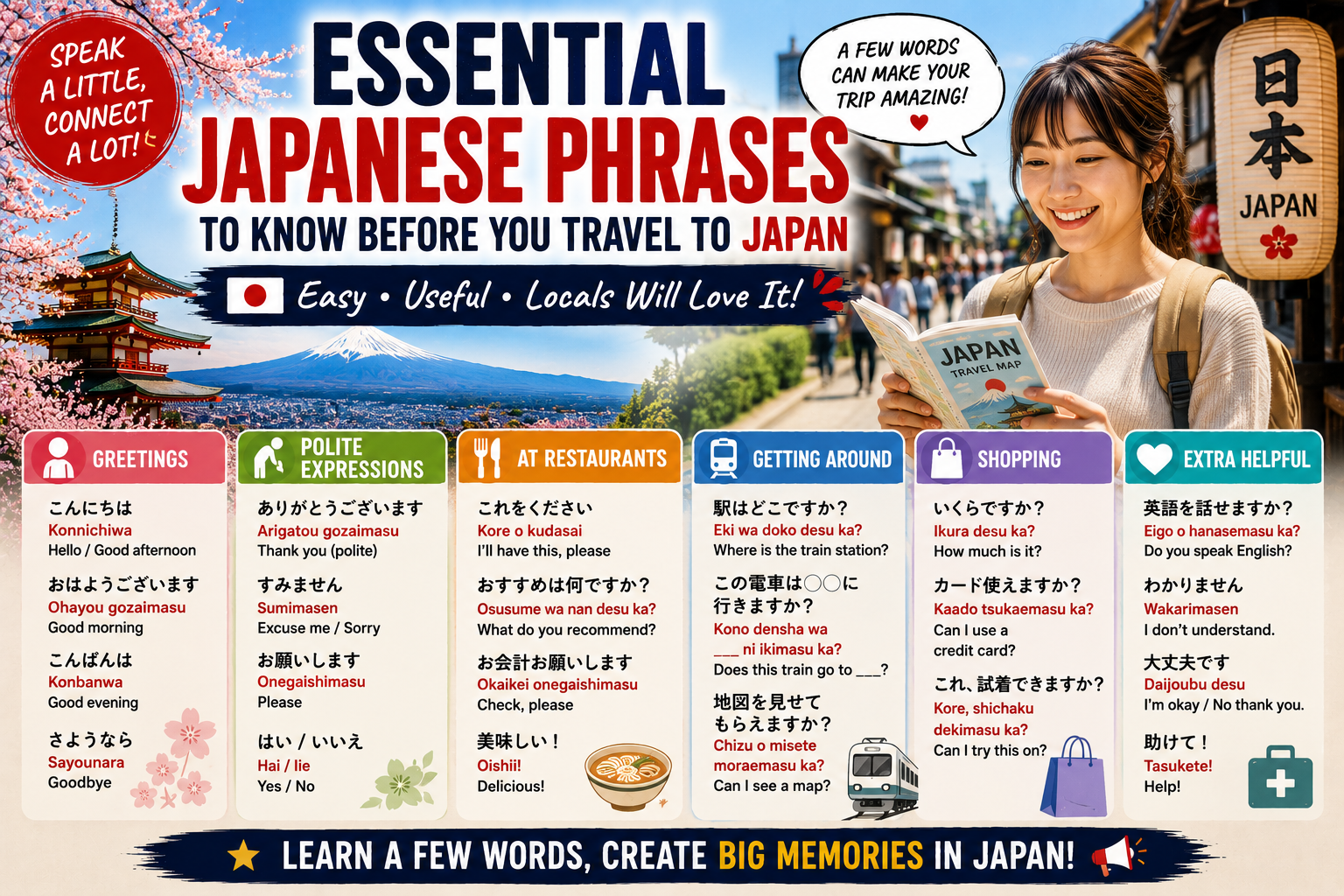
Basic Greetings
Greetings are an important part of Japanese culture.
Learning these expressions will help you make a positive first impression.
| Japanese | Pronunciation | Meaning |
|---|---|---|
| こんにちは | Konnichiwa | Hello / Good afternoon |
| おはようございます | Ohayō gozaimasu | Good morning |
| こんばんは | Konbanwa | Good evening |
| さようなら | Sayōnara | Goodbye |
| はじめまして | Hajimemashite | Nice to meet you |
| お元気ですか? | Ogenki desu ka? | How are you? |
For most travelers, simply saying Konnichiwa and smiling is enough.
Essential Polite Expressions
These may be the most important Japanese phrases you’ll learn.
ありがとうございます (Arigatou gozaimasu)
Meaning: Thank you
This is one of the most useful and appreciated phrases in Japan.
すみません (Sumimasen)
Meaning:
- Excuse me
- Sorry
- Thank you (in some situations)
Many foreigners are surprised to learn that this single phrase can solve countless problems in Japan.
お願いします (Onegaishimasu)
Meaning: Please
This phrase is used when making requests and sounds very polite.
はい (Hai)
Meaning: Yes
いいえ (Iie)
Meaning: No
Useful Japanese Phrases for Restaurants
Japanese restaurants are generally foreigner-friendly, but these expressions can make ordering much easier.
これをください (Kore o kudasai)
Meaning: I’ll have this, please.
This phrase is especially useful when pointing at a menu item.
おすすめは何ですか? (Osusume wa nan desu ka?)
Meaning: What do you recommend?
Many Japanese restaurant staff enjoy recommending their favorite dishes.
お会計お願いします (Okaikei onegaishimasu)
Meaning: Check, please.
美味しい! (Oishii!)
Meaning: Delicious!
Complimenting the food is always appreciated.
Getting Around Japan
Japan’s transportation system is excellent, but these phrases can help when you get lost.
駅はどこですか? (Eki wa doko desu ka?)
Meaning: Where is the train station?
この電車は〇〇に行きますか? (Kono densha wa ___ ni ikimasu ka?)
Meaning: Does this train go to ___?
Simply insert your destination.
地図を見せてもらえますか? (Chizu o misete moraemasu ka?)
Meaning: Can I see a map?
Although most travelers now use smartphones, this phrase can still be useful.
Shopping Phrases
Shopping in Japan is usually easy, but these phrases can help.
いくらですか? (Ikura desu ka?)
Meaning: How much is it?
カード使えますか? (Kaado tsukaemasu ka?)
Meaning: Can I use a credit card?
Although cashless payments are increasingly common, not every store accepts cards.
これ、試着できますか? (Kore, shichaku dekimasu ka?)
Meaning: Can I try this on?
Useful when shopping for clothes.
Emergency and Helpful Phrases
These expressions can be especially important.
英語を話せますか? (Eigo o hanasemasu ka?)
Meaning: Do you speak English?
わかりません (Wakarimasen)
Meaning: I don’t understand.
大丈夫です (Daijoubu desu)
Meaning:
- I’m okay.
- No, thank you.
- That’s fine.
This is one of the most versatile phrases in Japanese.
助けて! (Tasukete!)
Meaning: Help!
Hopefully, you’ll never need to use this one.
Do Japanese People Expect Tourists to Speak Japanese?
Not really.
Most Japanese people understand that international visitors may not speak Japanese.
However, making even a small effort often creates a positive impression.
Many Japanese people appreciate tourists who try to say:
- Hello
- Thank you
- Excuse me
- Please
Perfect pronunciation is not necessary.
Showing respect and effort matters far more.
Should You Learn Japanese Before Visiting Japan?
You don’t need to become fluent before your trip.
However, learning just 10 to 20 useful phrases can:
- Reduce travel stress
- Improve communication
- Create memorable experiences
- Help you connect with local people
Many travelers discover that using even basic Japanese makes their trip more enjoyable.
FAQ
Do I need to speak Japanese to travel in Japan?
No. Many tourist areas have English signs and services, but knowing basic Japanese can make your trip easier.
What is the most useful Japanese phrase for tourists?
Many travelers consider “Sumimasen” (Excuse me/Sorry) to be the most useful phrase.
Do Japanese people appreciate foreigners speaking Japanese?
Yes. Even a small effort is usually appreciated.
Is English widely spoken in Japan?
English ability varies, but major tourist destinations often provide English support.
What does “Daijoubu desu” mean?
It can mean “I’m okay,” “No thank you,” or “It’s fine,” depending on the situation.